Sunday, April 09, 2006

Is Ruby Ready for the Enterprise?

The team at MomentumSI asks the question, "Is Ruby Ready for the Enterprise?"

http://www.momentumsi.com/about/accessarchive.html

Saturday, April 01, 2006

You're so Enterprise...

The discussion of 'enterprise grade' and 'web grade' has been on the mind of the blogging community. David Heinemeier Hansson, with the recent Ruby on Rails success on his resume, recently branded an EA, "Boy, is James McGovern enterprise or what!" - let's be clear, this was meant as an insult.

He goes on to say, "Thus, allow me to make this perfectly clear: I would be as happy as a clam never to write a single line of software that guys like James McGovern found worthy of The Enterprise."

Recently, I asked some EA's to comment on this line of thinking. Putting the immature insults aside, were there valid points to be taken away?

Here is what I heard:
1. First, we can't just lump RSS, REST, RoR into the same bucket - each technology must be evaluated independently.

2. RSS can be viewed as an overlay network and has already proven to scale to the needs of the largest enterprises in the world. However, groups like MS have identified shortcomings and made feature extensions. This pattern will likely continue.

3. REST, as the principle foundation of the Web, has proven that it too can scale - but the areas where it has proven to scale the best are related to the movement of unstructured HTML documents using a constrained set of verbs. Others will note the success of RESTian API's in leading Web companies like Amazon. Most EA's were quick to acknowledge that the WS-stack is fat and that the lack of ubiquitous deployment was creating a larger than usual demand for simple RESTian style development. The delay of Microsoft Vista didn't help. EA's remain concerned that the lack of published resolutions to the non-functional concerns (security, reliability, transactional integrity) for RESTian projects will lead to either one-off implementations across the global enterprise leading to a deferred mediation problem, or alternatively might lead to a set of RESTian specifications that closely resembled the WS-specs, as they both attempted to satisfy the same use cases. The conclusions was that RESTian principles will make significant waves in the enterprise because of the solid foundation and ability to add more 'enterprise crap' on it if they need to.

4. Ruby on Rails - Generally speaking most of the EA's I've spoken with understood the power to quickly create web apps with RoR. One was quick to note, "if time to market was my primary concern, we'd use Cold Fusion, rarely is that the case." It was clear that many EA's were uneasy talking about RoR; they lacked data and were turned off by the comments that David Heinemeier Hansson had made, suggesting that Ruby was definitely interesting but were unsure if the RoR team was aware of the political nature of the enterprise - and the need to satisfy unique requirements. Most EA's were interested in finding a place to do 'departmental RoR' and kicking the tires. They were also interested in the long term potential of Ruby, RoR aside.

---- Part II
In regard to the comment that Dare had made, "If you are building distributed applications for your business, you really need to ask yourself what is so complex about the problems that you have to solve that makes it require more complex solutions than those that are working on a global scale on the World Wide Web today." I tried to have a conversation with several architects on this subject and we immediately ran into a problem. We were trying to compare and contrast a typical enterprise application with one like Microsoft Live. Not knowing the MS Live architecture we attempted to 'best guess' what it might look like:


  • An advanced presentation layer, probably with an advance portal mechanism
  • Some kind of mechanism to facilitate internationalization
  • A highly scalable 'logic layer'
  • A responsive data store (cached, but probably not transactional)
  • A traditional row of web servers / maybe Akamai thing thrown in
  • Some sort of user authentication / access control mechanism
  • A load balancing mechanism
  • Some kind of federated token mechanism to other MS properties
  • An outward facing API
  • Some information was syndicated via RSS
  • The bulk of the code was done is some OO language like Java or C#
  • Modularity and encapsulation was encouraged; loose coupling when appropriate
  • Some kind of systems management and monitoring
  • Assuming that we are capturing any sensitive information, an on the wire encryption mechanism
  • We guessed that many of the technologies that the team used were dictated to them: Let's just say they didn't use Java and BEA AquaLogic.
  • We also guessed that some of the typical stuff didn't make their requirements list (regulatory & compliance issues, interfacing with CICS, TPF, etc., interfacing with batch systems, interfacing with CORBA or DCE, hot swapping business rules, guaranteed SLA's, ability to monitor state of a business process, etc.)


At the end of the day - we were scratching our heads. We DON'T know the MS Live architecture - but we've got a pretty good guess on what it looks like - and ya know what? According to our mocked up version, it looked like all of our 'Enterprise Crap'.

So, in response to Dare's question of what is so much more complex about 'enterprise' over 'web', our response was "not much, the usual compliance and legacy stuff". However, we now pose a new question to Dare:
What is so much more simple about your architecture than ours?

Saturday, March 25, 2006

My Enterprise Makes Your Silly Product Look Like A Grain of Sand

Dare Obasanjo, a Microsoft engineer recently posted the following comment:

The funny thing about a lot of the people who claim to be 'Enterprise Architects' is that I've come to realize that they tend to seek complex solutions to relatively simple problems. How else do you explain the fact that web sites that serve millions of people a day and do billions of dollars in business a year like Amazon and Yahoo are using scripting languages like PHP and approaches based on REST to solve the problem of building distributed applications while you see these 'enterprise architect' telling us that you need complex WS-* technologies and expensive toolkits to build distributed applications for your business which has less issues to deal with than the Amazons and Yahoos of this world?


Dare goes on to say:
I was chatting with Dion Hinchcliffe at the Microsoft SPARK workshop this weekend and I asked him who the audience was for his blog on Web 2.0. He mentioned that he gets thousands of readers who are enterprise developers working for government agencies and businesses who see all the success that Web companies are having with simple technologies like RSS and RESTful web services while they have difficulty implementing SOAs in their enterprises for a smaller audience than these web sites. The lesson here is that all this complexity being pushed by so-called enterprise architects, software vendors and big 5 consulting companies is bullshit. If you are building distributed applications for your business, you really need to ask yourself what is so complex about the problems that you have to solve that makes it require more complex solutions than those that are working on a global scale on the World Wide Web today.


I guess that this gets to my point. Most people who have never seen a large enterprise architecture have no concept of what it is. I'm not trying to imply that Dare is one of them, but stating the RSS and REST are cures to enterprise grade problems seems a bit myopic. So, to Dare's point - why is it more complex to do 'enterprise grade' over 'web grade'? This is the million dollar (or perhaps billion dollar) question.

Of course I have my views, but what are yours? Send me your thoughts jschneider-at-momentumsi.com and I'll recompile for publishing. My gut tells me that there is a pretty good argument to be had here - if Dare is right, I want to be the first to advise my customers. If he's wrong, well - I want to advise my customer of that too!

Friday, March 24, 2006

The Web is the Application

I was playing with Google Finance:
http://www.google.com/finance?q=WEBM and realized that the what used to be a static html page was now a highly interactive application. Of course, I am referencing all of the AJAX functionality that has been added. In many of our current AJAX apps, the focus has been to convert classic applications like email, word processing and spreadsheets into Web 2.0 apps.

The conversion of 'traditional' web pages to interactive apps deserves special attention. This is the science of blending information based on context, degrees of separation and providing the ability to quickly pivot the view. It seems as though there is a point where a web page is no longer really a web page but rather an contextually bound application. The art of blending information, informational views, navigation and functionality will likely be a critical talent of the next gen application developer.

Wednesday, March 22, 2006

Redneck SOA

I just found an old post of mine (almost four years ago):

http://schneider.blogspot.com/2002_12_01_schneider_archive.html#90283350

Sunday, March 19, 2006

An Enterprise View of Application Architecture


Just something to consider...

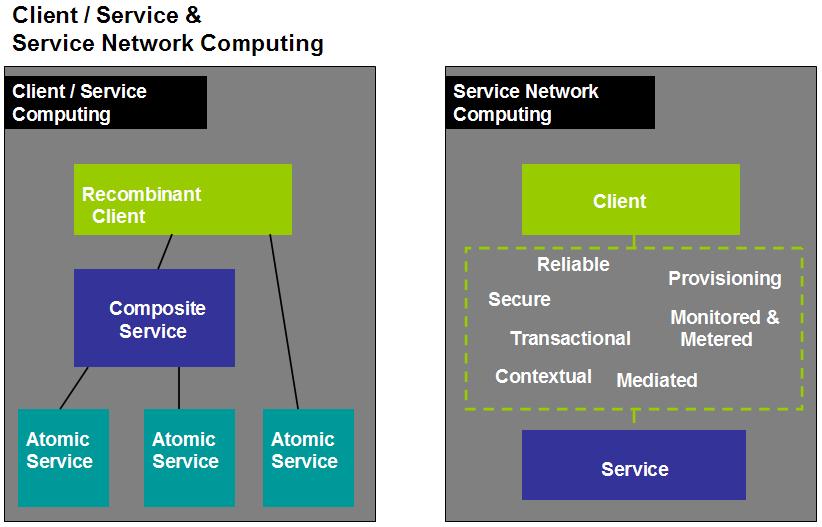
Client Service Computing

I'm starting to move away from the term "SOA" - I'm slowly starting to replace it with more specific terms. One is 'Client Service Computing', which focuses on a real simple use of clients to consume services (or composite services).


A second term that I've been using is "Service Network Computing" which focuses on the plumbing that makes hokey Web 2.0 applications capable of performing 'business critical' applications.

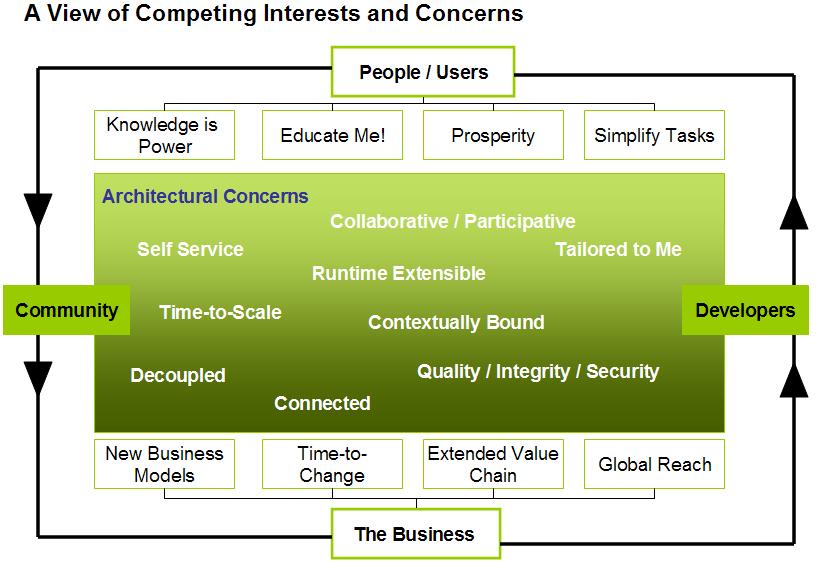
A View of Competing Interests and Concerns

One of the overarching themes of the Web 2.0 discussion we've had today focused on "Putting the User at the Center of the Universe". I wanted to make sure that we didn't leave off the other competing interests.


We always have to balance the needs of the business with the needs of the user. Our next generation architectures will be funded to enable next generation products, services, business models and value chains. And both User and Business will have architectural requirements which must be met. Perhaps taking a secondary seat is the needs of the developer. The hokey use of DHTML, AJAX, etc. perhaps is the most obvious indicator - we're jumping though hoops to meet the needs of users and business - IMHO, the way it should be until we get next-generation tooling.

Web 3.0 Maturity Model

I'm attending the Spark conference - a Microsoft sponsored event to discuss SOA, Software as a Service and Web 2.0.

The conversation has been a bit chaotic. It is clear that we are covering a lot of ground - perhaps too much ground. Architecting the future using terminology that is not baked isn't easy. All of the participants come from different backgrounds and have different views of what SOA is - what SaaS is - what Web 2.0 is. And no, we weren't able to find the silver bullet. I think we did make progress in finding some common ground about what is 'new' and 'different'.

The conversation has inspired a few thoughts around the aforementioned subjects. Again - no answers - perhaps more questions.

One of the discussion topics was Web 2.0 - although there was no conclusion on the tenets/philosophies of Web 2.0 a handful of attributes were repeated: User Centric, Self Service, Collaborative, Participative, Communal Organization, Lately Bound Composition, etc.

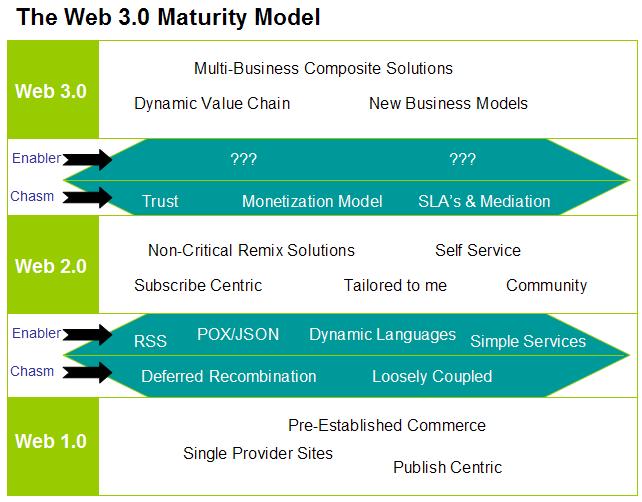
This led to yet another discussion about lack of 'mission critical' capabilities of the Web 2.0 and started the discussion of Web 3.0 - perhaps focusing more on the needs of the corporation. I put together the following illustration as a way to frame a discussion around the Web X.0:
What are the technical barriers?
What were the technical enablers?
What new capability did this enable the user or business?