Need a little help here...
I've received a few client requests for what I call, "service/relational mappers". In essence it is the same as object relational mapping but with web services. Here are the typical requirements:
1. Be able to both send and receive WS-I compliant web service messages
2. Ability to visually map an in-coming or out-going web service messages to a relational database schema (insert, update, delete, select)
3. "service oriented cron" - ability to wake up every so often, check the database and turn the new records into SOAP messages for outbound delivery.
4. Maintain a log of the activity
5. Send appropriate exceptions / errors
The key here is simple service to relational database mapping (DBMS vendor neutral).
If you've used a product or products that you are happy with, please send me a note:
jschneider@momentumsi.com
Monday, December 27, 2004

Sunday, December 26, 2004
Tuesday, December 21, 2004
Encapsulation, Polymorphism, Inheritance
Greg Vaughn, weighs-in on the "four tenets":
Here is the problem. Greg is one of the smartest developers I've ever met. For him, the concepts of SOA are obvious. He's a top 1% guy. The problem is the other 99%.
Remember, "Encapsulation, Polymorphism, Inheritance"? These were the basic ideas that the OO guys were trying to teach. They may not have hit the nail on the head but they did provide guidelines for developers.
Laws or rules aren't childish. They are the nourishment that leads us out of child-like naiveness.
"I mean no offense to those who are trying to nail down the fundamentals of what makes an architecture “service oriented”. For some it is a very handy way to organize their own knowledge. And there’s certainly a need to have laws for any developers on a project who have not reached the required maturity and experience levels, but in my opinion these should be more project specific rather than broad architectural category laws."
Here is the problem. Greg is one of the smartest developers I've ever met. For him, the concepts of SOA are obvious. He's a top 1% guy. The problem is the other 99%.
Remember, "Encapsulation, Polymorphism, Inheritance"? These were the basic ideas that the OO guys were trying to teach. They may not have hit the nail on the head but they did provide guidelines for developers.
Laws or rules aren't childish. They are the nourishment that leads us out of child-like naiveness.
Monday, December 20, 2004
Sun Launches the first pure “service oriented operating system”
Sun Launches the first pure “service oriented operating system”
PRESS RELEASE
On January 1st of 2006, Sun Microsystems is scheduled to release the world’s first service oriented operating system called SunStorm. The operating systems will be released under an open sourced license agreement, free to the public.
SunStorm is based around a new model of computing known as “web services”. Early versions of operating systems were primarily developed in structured programming languages like C and were often exposed to applications using ‘objects’. According to Sun, the internals of the operating system will continue to use these highly efficient techniques for things like disk operations and memory management, but the top layer of the system will now be completely service oriented.
SunStorm also has incorporated most of the capabilities of their last generation computing platform known as “J2EE”. New web services are provided inside the operating system to provide messaging, management, database connectivity and other “enterprise grade” functions. When asked about potential performance concerns, Sun representatives showcased their dynamic web service optimization techniques. Similar in concept to the “HotSpot compiler” release years earlier, SunStorm has the ability to dynamically determine the most performant mechanism to enable services to interact and in certain cases to recompile themselves into a single service which is later cached or deleted.
Sun is also rolling out their new tagline, “The Network is the Application”. This tagline replaces the old line of “The Network is the Computer”. With the launch of SunStorm, Sun is initiating a new era of loosely coupled, network computing for the enterprise.
Interestingly, Sun has not decided to enter into the development market for this space. Having learned from earlier mistakes made in their iPlanet group, Sun is now focusing on building out the operating system and supporting it for their enterprise customers. New to the Sun organization will be an emphasis on professional services.
Apparently, SunStorm has been years in the work only recently emerging from it’s stealth status. As part of this effort, Sun has end-of-lifed both it’s Jini and JXTA technologies. The J2EE technologies have been placed in a ‘mature’ status and will continue to be supported.
================================================================
This press release is 100% false. I completely made it up. However, it is really sad that it is 100% false.
PRESS RELEASE
On January 1st of 2006, Sun Microsystems is scheduled to release the world’s first service oriented operating system called SunStorm. The operating systems will be released under an open sourced license agreement, free to the public.
SunStorm is based around a new model of computing known as “web services”. Early versions of operating systems were primarily developed in structured programming languages like C and were often exposed to applications using ‘objects’. According to Sun, the internals of the operating system will continue to use these highly efficient techniques for things like disk operations and memory management, but the top layer of the system will now be completely service oriented.
SunStorm also has incorporated most of the capabilities of their last generation computing platform known as “J2EE”. New web services are provided inside the operating system to provide messaging, management, database connectivity and other “enterprise grade” functions. When asked about potential performance concerns, Sun representatives showcased their dynamic web service optimization techniques. Similar in concept to the “HotSpot compiler” release years earlier, SunStorm has the ability to dynamically determine the most performant mechanism to enable services to interact and in certain cases to recompile themselves into a single service which is later cached or deleted.
Sun is also rolling out their new tagline, “The Network is the Application”. This tagline replaces the old line of “The Network is the Computer”. With the launch of SunStorm, Sun is initiating a new era of loosely coupled, network computing for the enterprise.
Interestingly, Sun has not decided to enter into the development market for this space. Having learned from earlier mistakes made in their iPlanet group, Sun is now focusing on building out the operating system and supporting it for their enterprise customers. New to the Sun organization will be an emphasis on professional services.
Apparently, SunStorm has been years in the work only recently emerging from it’s stealth status. As part of this effort, Sun has end-of-lifed both it’s Jini and JXTA technologies. The J2EE technologies have been placed in a ‘mature’ status and will continue to be supported.
================================================================
This press release is 100% false. I completely made it up. However, it is really sad that it is 100% false.
Sunday, December 19, 2004
The Four Tenets of SOA
As we near this Christmas holiday, it seems only appropriate to throw the bible into my opponent's face :-)
Consider the following:
'You shall love your neighbor as yourself.' - (can, shall, may, etc.)
'Don't bang your neighbor's wife' - (don't, shall not, etc.)
Subtle difference? I don't think so. Imagine the first "rule" without the second "rule". Talk about a HUGE clarification!
You see, leaving room for interpretation leads to problems. That's why the Four Tenets of SOA are utterly useless (even as philosophies). Don't do X; Don't do Y. Don't do Z. Simple isn't it? Constraints. Ok, hopefully I've established the difference between philosophy and constraints. That said, let's go back and take a look at the four tenets that Don Box provides us peons to guide our professional existence for the next decade:
Boundaries are Explicit
Point: Because each cross-boundary communication is potentially costly, service-orientation is based on a model of explicit message passing rather than implicit method invocation.
Response: This is the "distribute OO was a failure" rule. Rather than saying
A. Distributed OO was a failure because Microsoft screwed the CORBA guys and fragmented the space.
B. Distributed OO was a failure because CORBA was a pain in the ass and it was competing in a rough market (BPR with 2-tier RAD and RAD groupware).
C. Distributed objects was a failure because we didn't adequately factor out the non-functional concerns and network programming was in its infancy.
No, rather than saying A,B or C - Microsoft says "Distributed objects failed because programmers were so stupid that they couldn't tell the difference between local and remote calls. Their solution was simple. Make remote calls a pain in the ass (oops, I mean ... make them non-primitives.) Yes, create some sort of language add-on (an API?) that mandates a mapping layer between the internal type system and the 'generic' type system - that'll teach those stupid programmers to realize when it's local and when it's remote! Oh, but let's also build runtime optimization of local service calls into the Indigo stack just to mess with them!!!
Sweet.
In case you're wondering, the constraint for 'boundaries are explicit' is this:
"language designers and extension builders SHALL NOT create a programming extension or primitive that enables service calls to be or appear to be first order primitives." (This might be the rule, but I can't wait to break it!!!)
The second part of 'boundaries are explicit' is: "The notion that boundaries are explicit applies not only to inter-service communication but also to inter-developer communication...." For the life of me, I can't find a rule, philosophy or anything actionable in this one.
==================================================================
Services are Autonomous
This is a case of bad terminology and description (I believe). If I understand Box correctly, his real intent was this line, "services are almost always deployed atomically". Whew... that was hard. Let's cut to the end and find the constraints:
1. Newly versioned services MUST BE deployed in a manner that DOES NOT negatively affect the prior version.
The second part of 'services are autonomous' states: "Service-orientation encourages a model that increases ubiquity by reducing the complexity of service interactions."
Here, Box takes jumps out of the versioning issue and lands in the 'loosely coupled' issue... although, in perhaps the most ambiguous manner possible. All I can offer is that if you want loose coupling to be a tenet, than you have to make an effort to create an index on loose coupling . Saying that 'leaking intentions is bad' doesn't quite do it for me.
==================================================================
Services share schema and contract, not class
Box states, "Rather, services interact based solely on schemas (for structures) and contracts (for behaviors)." Schema and contract only? Crap, we have to kill SOAP with Attachments and DIME ;-)
I've stated before... I don't have a good answer for this one... the problems with this tenet are clear: sharing binary information, passing predicates, bypassing the schemas with optimizations and sharing instructions other than classes like DSL's and metalogic.
==================================================================
Service compatibility is determined based on policy
Again, I agree.
Rule: Service consumer MUST be able to determine the capabilities of a provider via a publicly accessible, standard policy.
==================================================================
Now, I know that Don Box didn't mean for these to be rules... just some high level philosophies. However, if you watch the MS video, you'll see the MS-band-of-jokers butcher his material.
Back to my original point; we need simple rules or someone might accidentally misunderstand things like 'love your neighbor'. It's all about constraints. :-)
Consider the following:
'You shall love your neighbor as yourself.' - (can, shall, may, etc.)
'Don't bang your neighbor's wife' - (don't, shall not, etc.)
Subtle difference? I don't think so. Imagine the first "rule" without the second "rule". Talk about a HUGE clarification!
You see, leaving room for interpretation leads to problems. That's why the Four Tenets of SOA are utterly useless (even as philosophies). Don't do X; Don't do Y. Don't do Z. Simple isn't it? Constraints. Ok, hopefully I've established the difference between philosophy and constraints. That said, let's go back and take a look at the four tenets that Don Box provides us peons to guide our professional existence for the next decade:
Boundaries are Explicit
Point: Because each cross-boundary communication is potentially costly, service-orientation is based on a model of explicit message passing rather than implicit method invocation.
Response: This is the "distribute OO was a failure" rule. Rather than saying
A. Distributed OO was a failure because Microsoft screwed the CORBA guys and fragmented the space.
B. Distributed OO was a failure because CORBA was a pain in the ass and it was competing in a rough market (BPR with 2-tier RAD and RAD groupware).
C. Distributed objects was a failure because we didn't adequately factor out the non-functional concerns and network programming was in its infancy.
No, rather than saying A,B or C - Microsoft says "Distributed objects failed because programmers were so stupid that they couldn't tell the difference between local and remote calls. Their solution was simple. Make remote calls a pain in the ass (oops, I mean ... make them non-primitives.) Yes, create some sort of language add-on (an API?) that mandates a mapping layer between the internal type system and the 'generic' type system - that'll teach those stupid programmers to realize when it's local and when it's remote! Oh, but let's also build runtime optimization of local service calls into the Indigo stack just to mess with them!!!
Sweet.
In case you're wondering, the constraint for 'boundaries are explicit' is this:
"language designers and extension builders SHALL NOT create a programming extension or primitive that enables service calls to be or appear to be first order primitives." (This might be the rule, but I can't wait to break it!!!)
The second part of 'boundaries are explicit' is: "The notion that boundaries are explicit applies not only to inter-service communication but also to inter-developer communication...." For the life of me, I can't find a rule, philosophy or anything actionable in this one.
==================================================================
Services are Autonomous
This is a case of bad terminology and description (I believe). If I understand Box correctly, his real intent was this line, "services are almost always deployed atomically". Whew... that was hard. Let's cut to the end and find the constraints:
1. Newly versioned services MUST BE deployed in a manner that DOES NOT negatively affect the prior version.
The second part of 'services are autonomous' states: "Service-orientation encourages a model that increases ubiquity by reducing the complexity of service interactions."
Here, Box takes jumps out of the versioning issue and lands in the 'loosely coupled' issue... although, in perhaps the most ambiguous manner possible. All I can offer is that if you want loose coupling to be a tenet, than you have to make an effort to create an index on loose coupling . Saying that 'leaking intentions is bad' doesn't quite do it for me.
==================================================================
Services share schema and contract, not class
Box states, "Rather, services interact based solely on schemas (for structures) and contracts (for behaviors)." Schema and contract only? Crap, we have to kill SOAP with Attachments and DIME ;-)
I've stated before... I don't have a good answer for this one... the problems with this tenet are clear: sharing binary information, passing predicates, bypassing the schemas with optimizations and sharing instructions other than classes like DSL's and metalogic.
==================================================================
Service compatibility is determined based on policy
Again, I agree.
Rule: Service consumer MUST be able to determine the capabilities of a provider via a publicly accessible, standard policy.
==================================================================
Now, I know that Don Box didn't mean for these to be rules... just some high level philosophies. However, if you watch the MS video, you'll see the MS-band-of-jokers butcher his material.
Back to my original point; we need simple rules or someone might accidentally misunderstand things like 'love your neighbor'. It's all about constraints. :-)
Friday, December 17, 2004
"Schneider... you ignorant slut!"
Like every other morning... I woke up, made coffee and read my emails. One email caught my attention; it was titled, "Schneider... you ignorant slut". Clearly, this one deserved immediate attention :-) Yes, it was another 'anonymous' WS-CTO laughing at me for getting BlogSlapped by Jef Newsome.
Well, I thought I was going to make it all the way through 2004 without a good whipping. Thank God for people like Jef. Block, block, kick, block, punch... here we go...
======================
Jeff said: "All exchanges of data, metadata, logic or other binary asset MUST BE exchanged through a contract. Runtime changes to code dependencies are NOT allowed."
Jef commented: "Boundaries are explicit" is about the fact that you can't see what kind of underpants I am wearing."
Agreed. To me a 'contract' is a combination of the interface and the policies. The contract should black box both functional and non-functional requirements. The failure to block box non-functional requirements was the limiting force of components and the primary driver to move to services. However, neither of us answered the "boundaries are explicit, except for predicates" problem. (Not that I expect us to, but people like MS can't just punt on it either.)
=======================
Jef commented: "I have absolutely no idea what "Runtime changes to code dependencies are NOT allowed" has to do with explicitness of boundaries. In my estimation, nothing. I can think of a number of ways that runtime code dependencies could change in the context of a service oriented system, and everything would be just fine."
It was an example of a constraint - perhaps a bad example, but an example of a constraint. My point was that we need a constraint based description language for the architecture; I wasn't really trying to write the architectural constraint language. The constraints will be probably number in the hundreds, not four or six. That was my real point.
======================
Jef says, "I believe that services *should* be autonomous, that their implementation dependency on other services is an implementation detail (because boundaries are explicit), and part of the responsibility of an autonomous service is to gracefully degrade service when its dependencies have availability or other issues."
It sounds like you believe that a service is autonomous as long as the 'boundaries are explicit' rule is enforced; if that is the case, then this is a duplicate rule and we should remove it. I'm game. I've been game - it sends the wrong message.
I firmly believe that enterprises will eventually be required to migrate to Model 4 services. Yes, their boundaries will be explicit, but their lack of sovereignty or self governance will be more significant. Services will NOT be viewed as single individual entities, but as ecosystems of contracts that need to migrate together.
As we move from noun-first programming to verb-first, we find ourselves dealing with "cross-cutting subjects" (not concerns) that have to be dealt with as a group. What I have found is that the 'verb' holds still while everything else changes (noun, adjective, predicate, context). This isn't to say that you can't have autonomous services; you can. However, I don't believe this approach will work from an economic perspective. I'm probably talking more about the 'development-time' aspect of autonomy than the runtime aspect; however after re-reading the MS description, I have no idea what they were talking about. Their description is largely just a bunch of mumbo-jumbo. They mixed a half dozen concepts under this one tenet that largely don't even relate to each other. If you want to turn "services are autonomous" into a set of constraints, I'd love to see them.
======================
Jef: And I trust he can explain what he means in a way that someone as simple as me can understand. I hope he does, because I don't get it.
My goal isn't to explain it in the simplest fashion, but in the most precise fashion. I want to take the current state of WS-MumboJumbo and bring clarity via a set of constraints. A tenet should be a set of constraints rolled together to satisfy a high-level architectural requirement. Walking into the next paradigm of computing without constraint based design practices is silly, insulting and financially dangerous.
Well, I thought I was going to make it all the way through 2004 without a good whipping. Thank God for people like Jef. Block, block, kick, block, punch... here we go...
======================
Jeff said: "All exchanges of data, metadata, logic or other binary asset MUST BE exchanged through a contract. Runtime changes to code dependencies are NOT allowed."
Jef commented: "Boundaries are explicit" is about the fact that you can't see what kind of underpants I am wearing."
Agreed. To me a 'contract' is a combination of the interface and the policies. The contract should black box both functional and non-functional requirements. The failure to block box non-functional requirements was the limiting force of components and the primary driver to move to services. However, neither of us answered the "boundaries are explicit, except for predicates" problem. (Not that I expect us to, but people like MS can't just punt on it either.)
=======================
Jef commented: "I have absolutely no idea what "Runtime changes to code dependencies are NOT allowed" has to do with explicitness of boundaries. In my estimation, nothing. I can think of a number of ways that runtime code dependencies could change in the context of a service oriented system, and everything would be just fine."
It was an example of a constraint - perhaps a bad example, but an example of a constraint. My point was that we need a constraint based description language for the architecture; I wasn't really trying to write the architectural constraint language. The constraints will be probably number in the hundreds, not four or six. That was my real point.
======================
Jef says, "I believe that services *should* be autonomous, that their implementation dependency on other services is an implementation detail (because boundaries are explicit), and part of the responsibility of an autonomous service is to gracefully degrade service when its dependencies have availability or other issues."
It sounds like you believe that a service is autonomous as long as the 'boundaries are explicit' rule is enforced; if that is the case, then this is a duplicate rule and we should remove it. I'm game. I've been game - it sends the wrong message.
I firmly believe that enterprises will eventually be required to migrate to Model 4 services. Yes, their boundaries will be explicit, but their lack of sovereignty or self governance will be more significant. Services will NOT be viewed as single individual entities, but as ecosystems of contracts that need to migrate together.
As we move from noun-first programming to verb-first, we find ourselves dealing with "cross-cutting subjects" (not concerns) that have to be dealt with as a group. What I have found is that the 'verb' holds still while everything else changes (noun, adjective, predicate, context). This isn't to say that you can't have autonomous services; you can. However, I don't believe this approach will work from an economic perspective. I'm probably talking more about the 'development-time' aspect of autonomy than the runtime aspect; however after re-reading the MS description, I have no idea what they were talking about. Their description is largely just a bunch of mumbo-jumbo. They mixed a half dozen concepts under this one tenet that largely don't even relate to each other. If you want to turn "services are autonomous" into a set of constraints, I'd love to see them.
======================
Jef: And I trust he can explain what he means in a way that someone as simple as me can understand. I hope he does, because I don't get it.
My goal isn't to explain it in the simplest fashion, but in the most precise fashion. I want to take the current state of WS-MumboJumbo and bring clarity via a set of constraints. A tenet should be a set of constraints rolled together to satisfy a high-level architectural requirement. Walking into the next paradigm of computing without constraint based design practices is silly, insulting and financially dangerous.
Tuesday, December 14, 2004
Service Creation Styles
At Momentum SI, we've been working on an EA framework for producing reference architectures and candidate architectures. This work has an emphasis on SOA but also considers many of the other architectural remedies.
One aspect of an architecture is the style that is used to create/execute a service. Although we've seen many variations, here is our high level categorization scheme:


Note that this doesn't cover registries, configuration management, version control or other essential part of the architecture. Those remedies are covered in other areas of our SOA reference architectures.
One aspect of an architecture is the style that is used to create/execute a service. Although we've seen many variations, here is our high level categorization scheme:
Note that this doesn't cover registries, configuration management, version control or other essential part of the architecture. Those remedies are covered in other areas of our SOA reference architectures.
Thursday, December 09, 2004
The Death of Software?
Paul Brown had commented on a note from Eric Newcomer on the "death of software":
Oh me, oh my. I've been there before - when you just run out of steam and everything looks grey; progress halts and the future dims. The good news is that history tells us that this is dead wrong.
Where to begin? Software remains in a pre-natal stage (not even infancy). I still think is hysterical that I type on a keyboard, look at a fixed monitor, and have to tell the computer what I want it to do. I'm amazed that I am so much smarter than my computer - this is just silly. I hate the fact that the state of artificial imagination is at ground zero, that we don't have digital metaphors and that a computer can't reverse engineer strategy. I think it is funny that we continue to use silicon at the computing substrate, that our programs are explicitly programmed and that they are not self-improving.
Maybe I'm just a kid at heart. Maybe I'm too stupid to know the obstacles. Either way, I am thankful. May I continue to be cursed with creationary optimism.
And may I offer an ounce of optimism to those of you who wore black pants and white shirts today. When your desk is scattered with employee status reports, when your walls speak of posters of UML and Java libraries from 5 years ago, it is time for a change. Not a little change, but a big change. Web services, orchestration, intermediaries, blah, blah, blah - these are the incremental improvements decades in the work. Refill your mind with childlike optimism. Imagine. Invent. Destroy. Laugh. Repeat.
"The most significant inventions are over. Some would call this the "death of software." But only as we know it. Software will continue. But we are not likely to have any new languages, or see any significant new inventions. Twenty years ago no one knew what a database was, or middleware, or Java. But now I think innovation like that has stopped because IT doesn't need it any more."
Oh me, oh my. I've been there before - when you just run out of steam and everything looks grey; progress halts and the future dims. The good news is that history tells us that this is dead wrong.
Where to begin? Software remains in a pre-natal stage (not even infancy). I still think is hysterical that I type on a keyboard, look at a fixed monitor, and have to tell the computer what I want it to do. I'm amazed that I am so much smarter than my computer - this is just silly. I hate the fact that the state of artificial imagination is at ground zero, that we don't have digital metaphors and that a computer can't reverse engineer strategy. I think it is funny that we continue to use silicon at the computing substrate, that our programs are explicitly programmed and that they are not self-improving.
Maybe I'm just a kid at heart. Maybe I'm too stupid to know the obstacles. Either way, I am thankful. May I continue to be cursed with creationary optimism.
And may I offer an ounce of optimism to those of you who wore black pants and white shirts today. When your desk is scattered with employee status reports, when your walls speak of posters of UML and Java libraries from 5 years ago, it is time for a change. Not a little change, but a big change. Web services, orchestration, intermediaries, blah, blah, blah - these are the incremental improvements decades in the work. Refill your mind with childlike optimism. Imagine. Invent. Destroy. Laugh. Repeat.
Wednesday, December 08, 2004
Stuck in the Middle
This is from a slide deck that was put together in 1997:
The [I] box stands for 'intermediary'.
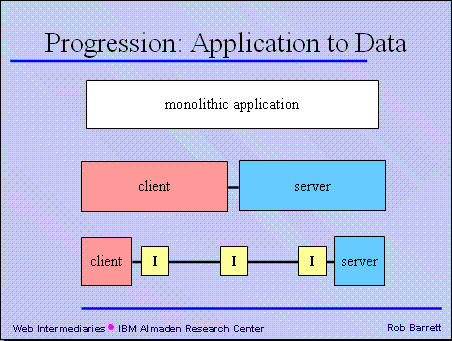
See: http://www.almaden.ibm.com/cs/wbi/Publications.html
Intermediary-based programming is still an art. Everyone wants to talk about services... service oriented this, service oriented that... but no one want to talk about "intermediary oriented". I guess it isn't very sexy. I've challenged the SO group to discuss the NFR's of an intermediary; should be interesting. I've also had some interesting discussions on the categories of intermediaries, including stateless, stateful, 'context oriented', header-only processing, payload processing and more.
I have a feeling that a significant focus of 2005 will be on the intermediary programming model. We'll see great discussions on IOD (design) and IOA (architecture) and refactoring portions of fat services into bumps on the network.
The [I] box stands for 'intermediary'.
See: http://www.almaden.ibm.com/cs/wbi/Publications.html
Intermediary-based programming is still an art. Everyone wants to talk about services... service oriented this, service oriented that... but no one want to talk about "intermediary oriented". I guess it isn't very sexy. I've challenged the SO group to discuss the NFR's of an intermediary; should be interesting. I've also had some interesting discussions on the categories of intermediaries, including stateless, stateful, 'context oriented', header-only processing, payload processing and more.
I have a feeling that a significant focus of 2005 will be on the intermediary programming model. We'll see great discussions on IOD (design) and IOA (architecture) and refactoring portions of fat services into bumps on the network.
Sunday, December 05, 2004
The Financial CIO
A great quote from a recent Sterling-Hoffman newsletter:
Angel Mehta: Why do you think the climate is so difficult for enterprise software companies, even with the economy having recovered?
Stu Schuster: For as long as I can remember, the process of growing a company has been the Geoffrey Moore, ‘Crossing the Chasm’ approach. When taking technology to market, find the innovators first who buy the technology, and then you go through the early adopters and late adopters, etc. This process, I think, all good high-tech marketers understood.
Throughout my entire career, there were always people who wanted to do something for their organizations that they believed would be a leap forward and would make a name for themselves. Call these the entrepreneurial Chief Information Officer… they were at companies like FedEx or Wal-Mart. They would try to do something with technology that would give the entire company a competitive edge.
After the technology crash, the focus became so oriented around cost-cutting that the entrepreneurial CIO was replaced with a financial CIO. There are so few entrepreneurial CIO’s out there that today everything has to be easy to implement, available by the drink, with very short time to ROI. The innovative buyer, the entrepreneurial CIO has been terminated out of the industry.
Eventually, it’ll cycle again because people will eventually feel that they’ll need a competitive advantage and will look to technology to do that. But today, it’s brutal. It’s amazing how hard it is to find people who are willing to take a chance on a new company or new technology. Fear dominates every IT department. As a result, growing an early stage software company is just harder than ever.
That’s why I place so much more emphasis on the people-side of the equation these days. It doesn’t matter how great the technology is – if the right people aren’t in place, you’ll never convince customers to take a chance.
Angel Mehta: Why do you think the climate is so difficult for enterprise software companies, even with the economy having recovered?
Stu Schuster: For as long as I can remember, the process of growing a company has been the Geoffrey Moore, ‘Crossing the Chasm’ approach. When taking technology to market, find the innovators first who buy the technology, and then you go through the early adopters and late adopters, etc. This process, I think, all good high-tech marketers understood.
Throughout my entire career, there were always people who wanted to do something for their organizations that they believed would be a leap forward and would make a name for themselves. Call these the entrepreneurial Chief Information Officer… they were at companies like FedEx or Wal-Mart. They would try to do something with technology that would give the entire company a competitive edge.
After the technology crash, the focus became so oriented around cost-cutting that the entrepreneurial CIO was replaced with a financial CIO. There are so few entrepreneurial CIO’s out there that today everything has to be easy to implement, available by the drink, with very short time to ROI. The innovative buyer, the entrepreneurial CIO has been terminated out of the industry.
Eventually, it’ll cycle again because people will eventually feel that they’ll need a competitive advantage and will look to technology to do that. But today, it’s brutal. It’s amazing how hard it is to find people who are willing to take a chance on a new company or new technology. Fear dominates every IT department. As a result, growing an early stage software company is just harder than ever.
That’s why I place so much more emphasis on the people-side of the equation these days. It doesn’t matter how great the technology is – if the right people aren’t in place, you’ll never convince customers to take a chance.
Thursday, December 02, 2004
The Role of the Application Servers in SOA
I've been using the term "service containers" to refer to the sandbox that services live in. However, in J2EE land, there isn't a 1:1 relationship between the 'software server' and the 'container'. You've got the 'servlet container', 'ejb container', etc. The Application Server is really an all-in-one - super-duper server. It slices, it dices, it does transactions, messages, web pages - you name it - it does it.
App servers can host web services. They can also host platform specific services (RMI, EJB). The services provided can be governed via the container and can leverage additional functionality via components and class libraries (most of the J2EE API's).
Just to restate - build services on top of components that are a combination of classes which sit inside of a governed container while making calls to libraries, some of which are runtime generators, perhaps being fed metadata from model-driven tooling. Agreed?
Ok. Now we need to move into "specialized servers", like identity servers, orchestration servers, etc. Many of these servers were built from the ground up as stand-alone servers, while other implementations were built to sit on top of application servers (e.g., a bpel implementation that runs in JBoss). In the J2EE world, specialized servers are really just new API's governed by the JSR process to encourage yet another container or library to be added to the J2EE server. In some ways, J2EE has become a dumping ground for 'bright ideas'. Hence the movement to 'lightweight containers'.
Now, let's ponder...
Question #1: Would you describe the application server as a "Rapid Service Development" (RSD) environment?
Question #2: To what extent should specialized services reside in generic containers?
Question #3: Should the server be 'pre-glued' together (mandate the download all 55MB of libraries) or should it be more loosely coupled and segmented?
Question #4: What are the necessary cross-cutting concerns that should be considered part of the server or container?
Question #5: What functionality is not a cross-cutting concern, but rather a specialized function?
Question #6: Would you consider the app server to be a "Contract First Container"?
The application server has evolved to meet the needs of the masses. It was designed to be an all-purpose server. Can a developer build SOA based applications in it? Sure. It is more work than it needs to be? Absolutely. And the big question... Do I believe that Rapid Service Development to Contract-First Containers is the way of the future? Yes I do.
Application servers will continue to be used when the architect chooses to use a platform specific component-based development model. Here, the focus is on 'building the application' (hence, "application server") versus building the services.
There are some real challenges that app servers will face in the SOA environment. We can be sure that BEA and IBM will be morphing their offerings to make them more acceptable to the SOA crowd. However, I fear that they will leave all of the garbage behind as well.
It's real simple - if your platform fails the loosely coupled test then so will your business applications that sit on top of them.
Remember: "Rapid Service Development to Contract-First Containers".
App servers can host web services. They can also host platform specific services (RMI, EJB). The services provided can be governed via the container and can leverage additional functionality via components and class libraries (most of the J2EE API's).
Just to restate - build services on top of components that are a combination of classes which sit inside of a governed container while making calls to libraries, some of which are runtime generators, perhaps being fed metadata from model-driven tooling. Agreed?
Ok. Now we need to move into "specialized servers", like identity servers, orchestration servers, etc. Many of these servers were built from the ground up as stand-alone servers, while other implementations were built to sit on top of application servers (e.g., a bpel implementation that runs in JBoss). In the J2EE world, specialized servers are really just new API's governed by the JSR process to encourage yet another container or library to be added to the J2EE server. In some ways, J2EE has become a dumping ground for 'bright ideas'. Hence the movement to 'lightweight containers'.
Now, let's ponder...
Question #1: Would you describe the application server as a "Rapid Service Development" (RSD) environment?
Question #2: To what extent should specialized services reside in generic containers?
Question #3: Should the server be 'pre-glued' together (mandate the download all 55MB of libraries) or should it be more loosely coupled and segmented?
Question #4: What are the necessary cross-cutting concerns that should be considered part of the server or container?
Question #5: What functionality is not a cross-cutting concern, but rather a specialized function?
Question #6: Would you consider the app server to be a "Contract First Container"?
The application server has evolved to meet the needs of the masses. It was designed to be an all-purpose server. Can a developer build SOA based applications in it? Sure. It is more work than it needs to be? Absolutely. And the big question... Do I believe that Rapid Service Development to Contract-First Containers is the way of the future? Yes I do.
Application servers will continue to be used when the architect chooses to use a platform specific component-based development model. Here, the focus is on 'building the application' (hence, "application server") versus building the services.
There are some real challenges that app servers will face in the SOA environment. We can be sure that BEA and IBM will be morphing their offerings to make them more acceptable to the SOA crowd. However, I fear that they will leave all of the garbage behind as well.
It's real simple - if your platform fails the loosely coupled test then so will your business applications that sit on top of them.
Remember: "Rapid Service Development to Contract-First Containers".
Tuesday, November 30, 2004
MS Patterns & Practices are Shallow
The Microsoft Patterns & Practices group released a set of SOA principles. I was eager to see what the brains came up with but found myself beyond disappointed; I found myself actually in awe of their incompetence. Perhaps these are tough words but I'm so extremely disappointed in the group-think that is currently going on in the SOA world that I feel compelled to point it out.
First, the show can be found here:
http://msevents.microsoft.com/cui/WebCastEventDetails.aspx?culture=en-US&EventID=1032262538&CountryCode=US
MS stated four primary tenets to SOA. My first thought was "holy smokes, they got it down to four?!!!" Well, here they are:
1. Boundaries are explicit
2. Services are autonomous
3. Services share schema and contract, not class
4. Service compatibility is based on policy
Boundaries are explicit - yep, hard to argue. But what does this actually say? How about this instead: "All exchanges of data, metadata, logic or other binary asset MUST BE exchanged through a contract. Runtime changes to code dependencies are NOT allowed."
Services are autonomous - Most people know that I firmly believe that "services are not autonomous", they are synergistic. Services work together in a 'service ecosystem'. Services will influence each others metadata. In no way are services autonomous.
Services share schema and contract, not class - I believe the point is that you want to share data using self describing, self validating, extensible schema systems that are ubiquitously deployed. That's cool - use an abstract typing system.
Service compatibility is based on policy - Yes. Agreed.
The patterns group then identified some "anti-patterns" or things not to do:
1. Avoid CRUDy interfaces. Don't use the CRUD pattern.
Guys - this is so wrong I felt sorry for them. After listening to them babble on this for a while all credibility was lost. I think what they meant to say is "Use CRUD, but don't violate the age-old wisdom around fully encapsulating and abstracting the persistence mechanisms. "
The second anti-pattern was avoid "loosely goosey" interfaces. The example they used was something like "runQuery(qry)". This one is tougher. If you really don't know what query combination needs to be run at design time then... you pretty much need something like "runQuery(qry)". This gets into a real interesting space that I wish MS would have talked about. Is it ok to pass XPath statement? Is it ok to pass an XQuery command? What is the right way to solve the runtime predicate problem? Surely the answer isn't "don't solve it". What about the surrogate key problem - where the only primary key is vendor specific key?
The list goes on and on... MS has the brains to do this stuff right. I wish they would ask some of their smart people to help the patterns & practice group get this stuff right.
First, the show can be found here:
http://msevents.microsoft.com/cui/WebCastEventDetails.aspx?culture=en-US&EventID=1032262538&CountryCode=US
MS stated four primary tenets to SOA. My first thought was "holy smokes, they got it down to four?!!!" Well, here they are:
1. Boundaries are explicit
2. Services are autonomous
3. Services share schema and contract, not class
4. Service compatibility is based on policy
Boundaries are explicit - yep, hard to argue. But what does this actually say? How about this instead: "All exchanges of data, metadata, logic or other binary asset MUST BE exchanged through a contract. Runtime changes to code dependencies are NOT allowed."
Services are autonomous - Most people know that I firmly believe that "services are not autonomous", they are synergistic. Services work together in a 'service ecosystem'. Services will influence each others metadata. In no way are services autonomous.
Services share schema and contract, not class - I believe the point is that you want to share data using self describing, self validating, extensible schema systems that are ubiquitously deployed. That's cool - use an abstract typing system.
Service compatibility is based on policy - Yes. Agreed.
The patterns group then identified some "anti-patterns" or things not to do:
1. Avoid CRUDy interfaces. Don't use the CRUD pattern.
Guys - this is so wrong I felt sorry for them. After listening to them babble on this for a while all credibility was lost. I think what they meant to say is "Use CRUD, but don't violate the age-old wisdom around fully encapsulating and abstracting the persistence mechanisms. "
The second anti-pattern was avoid "loosely goosey" interfaces. The example they used was something like "runQuery(qry)". This one is tougher. If you really don't know what query combination needs to be run at design time then... you pretty much need something like "runQuery(qry)". This gets into a real interesting space that I wish MS would have talked about. Is it ok to pass XPath statement? Is it ok to pass an XQuery command? What is the right way to solve the runtime predicate problem? Surely the answer isn't "don't solve it". What about the surrogate key problem - where the only primary key is vendor specific key?
The list goes on and on... MS has the brains to do this stuff right. I wish they would ask some of their smart people to help the patterns & practice group get this stuff right.
Tuesday, November 23, 2004
Languages are Less Important
"Languages are Less Important" is one of the simple philosophies in Awesome(tm):
Traditionally, the choice of programming languages in an I.T. department was a near-religous decision. One reason was that the language tended to slither its way from one application to the next. Knowing this, managers would be very careful about allowing a new language into a development shop. In addition, reuse was considered a language specific mining activity (no one tried to pull Java code out of one application and put it in a Perl application). On top of this was the obvious fact that all of the enterprise API's were language specific, including J2EE and .Net.
Enterprises that implement Contract First Design and believe that Platforms are Contract Driven are much less dependent on specific languages or language specific libraries. Now, with this said - languages are still important for some real good reasons including: Developers skilled in one language shouldn't have to learn a new language for every different service they run into. Most I.T. shops already have large investments in platform specific code bases that they will want to leverage.
Although languages are less important in a service oriented world, they are still important. As services become more popular it will be common to find languages which are more friendly towards service development. This may be based on their ability to work with the Web Service standards, to expose themselves as a service or to invoke a service.
Well, it seems as though Peter Yared understood this some time back. Unlike the scores of startups that re-create the same damn product using all the same damn technologies... ActiveGrid made a hard left turn. The company appears to have come to the obvious realizations that no one else seems to have the guts to admit:
1. J2EE is a bloated set of deprecated patches.
2. Static Java objects and dynamic XML collide
3. Contract first programming make "languages less important"
4. If you're in an SO world, you might as well pick an SO friendly language
5. J2EE was designed to scale across a VM that sits on a multi-CPU box
6. Oh, Sun owns Java and J2EE, and what do you know... they sell multi-CPU boxes
7. Rip & replace Intel/AMD/Linux boxes are fast, cheap and reliable
8. LAMP is here to stay.
9. The growth rate of transactions inside an enterprise is significant.
10. The last-gen computing method will hit an 'economic breaking point'.
ActiveGrid is a "market starter"; the door has just been opened to commoditize the OS, the language and the vm while kicking big boxes in the groin and enabling service developers to be more productive while offering a lower cost of computing. Interesting? Uh, yes.
Traditionally, the choice of programming languages in an I.T. department was a near-religous decision. One reason was that the language tended to slither its way from one application to the next. Knowing this, managers would be very careful about allowing a new language into a development shop. In addition, reuse was considered a language specific mining activity (no one tried to pull Java code out of one application and put it in a Perl application). On top of this was the obvious fact that all of the enterprise API's were language specific, including J2EE and .Net.
Enterprises that implement Contract First Design and believe that Platforms are Contract Driven are much less dependent on specific languages or language specific libraries. Now, with this said - languages are still important for some real good reasons including: Developers skilled in one language shouldn't have to learn a new language for every different service they run into. Most I.T. shops already have large investments in platform specific code bases that they will want to leverage.
Although languages are less important in a service oriented world, they are still important. As services become more popular it will be common to find languages which are more friendly towards service development. This may be based on their ability to work with the Web Service standards, to expose themselves as a service or to invoke a service.
Well, it seems as though Peter Yared understood this some time back. Unlike the scores of startups that re-create the same damn product using all the same damn technologies... ActiveGrid made a hard left turn. The company appears to have come to the obvious realizations that no one else seems to have the guts to admit:
1. J2EE is a bloated set of deprecated patches.
2. Static Java objects and dynamic XML collide
3. Contract first programming make "languages less important"
4. If you're in an SO world, you might as well pick an SO friendly language
5. J2EE was designed to scale across a VM that sits on a multi-CPU box
6. Oh, Sun owns Java and J2EE, and what do you know... they sell multi-CPU boxes
7. Rip & replace Intel/AMD/Linux boxes are fast, cheap and reliable
8. LAMP is here to stay.
9. The growth rate of transactions inside an enterprise is significant.
10. The last-gen computing method will hit an 'economic breaking point'.
ActiveGrid is a "market starter"; the door has just been opened to commoditize the OS, the language and the vm while kicking big boxes in the groin and enabling service developers to be more productive while offering a lower cost of computing. Interesting? Uh, yes.
Friday, November 19, 2004
"Design by Contract" or "Contract First"?
I'm trying to clean up some terminology that I've been using in the Awesome(tm) method. The latest is the term "design by contract(tm)". This is a term that Bertrand Meyer coined (and trademarked). He used it in the context of object oriented programming where the focus was on "pre- and post-conditions and class invariants".
Don Box, Christian Weyer and others have favored the term "contract first" to describe a similar concept more suitable to web services. Here the focus has been on giving a service the ability to advertise:
- Type definitions
- Message definitions
- Operations (inbound and outbound)
- Message Exchange Patterns (e.g., request/response)
- Interfaces (groups of operations)
- Bindings
However, it is apparent that the contract goes beyond the basic wsdl stuff. It must also include:
- Pre-conditions / post-condition assertions
- Non-functional policies (security, reliability, transactional integrity)
- Hosted service level agreements (availability, latency)
- Synchronicity capabilities (asynch, synch or bi-synch)
Eventually the contracts will include stuff like:
- Semantic ontology (or other semantic broker)
- Costing /recharge functions
- Estimates to run service (think big-O)
- Preferred translator service (don't understand SOAP 1.5, but do understand SOAP 1.3)
- Code mobility agreements
- Service-to-service automated recompilation agreements (HotSpot for SO)
- Service dependencies (other services and resources)
(many of these will show up as standardized interfaces implemented by a service container)
I guess what I'm saying is that "design by contract" doesn't mean the same thing that we are talking about in the service oriented world. Hence, "Contract First" it is!
-----
Here's one to ponder... what pieces of the contract should be in a document format (like WSDL) versus in an interface format (like ws-mex). Or should they be in both? Why doesn't WSDL have a WSDL interface: getOperations()?? Is the ws-mex, getMetadata() the right way to go? Or should you look at it as an enterprise vocabulary problem? "GET" + "OPERATION" (think ws-transfer). Or is it a semantic ontology problem where you have "GET" and a pre-condition stating you can only get things that 'are a kind of' "METADATA"... Well, doesn't really matter - looks like we will have every combination possible. :-)
Don Box, Christian Weyer and others have favored the term "contract first" to describe a similar concept more suitable to web services. Here the focus has been on giving a service the ability to advertise:
- Type definitions
- Message definitions
- Operations (inbound and outbound)
- Message Exchange Patterns (e.g., request/response)
- Interfaces (groups of operations)
- Bindings
However, it is apparent that the contract goes beyond the basic wsdl stuff. It must also include:
- Pre-conditions / post-condition assertions
- Non-functional policies (security, reliability, transactional integrity)
- Hosted service level agreements (availability, latency)
- Synchronicity capabilities (asynch, synch or bi-synch)
Eventually the contracts will include stuff like:
- Semantic ontology (or other semantic broker)
- Costing /recharge functions
- Estimates to run service (think big-O)
- Preferred translator service (don't understand SOAP 1.5, but do understand SOAP 1.3)
- Code mobility agreements
- Service-to-service automated recompilation agreements (HotSpot for SO)
- Service dependencies (other services and resources)
(many of these will show up as standardized interfaces implemented by a service container)
I guess what I'm saying is that "design by contract" doesn't mean the same thing that we are talking about in the service oriented world. Hence, "Contract First" it is!
-----
Here's one to ponder... what pieces of the contract should be in a document format (like WSDL) versus in an interface format (like ws-mex). Or should they be in both? Why doesn't WSDL have a WSDL interface: getOperations()?? Is the ws-mex, getMetadata() the right way to go? Or should you look at it as an enterprise vocabulary problem? "GET" + "OPERATION" (think ws-transfer). Or is it a semantic ontology problem where you have "GET" and a pre-condition stating you can only get things that 'are a kind of' "METADATA"... Well, doesn't really matter - looks like we will have every combination possible. :-)
Thursday, November 18, 2004
One of my favorites...
One of my favorite posts:
http://schneider.blogspot.com/2002_12_01_schneider_archive.html#90283350
(still waiting).
http://schneider.blogspot.com/2002_12_01_schneider_archive.html#90283350
(still waiting).
Saturday, November 13, 2004
Service Oriented Methodology
In 1998, a few of us at Momentum (James Higginbotham, Mark Spitzer, Ed French) wrote a software development method that we called Reality(tm). The method borrowed from best practices of Booch, Rumbaugh, Jacobson, Coad-Yourdan and Schaler-Mellor. Later we incorporated UML and concepts from Extreme Programming. We also threw in platform specific (Java & .Net) best practice guides and reference architectures. The Reality method has served us on over 100 engagements. I'll admit that we haven't always follow it to the letter of the law, but the intent seems to find its way into all of the projects.
However, at the heart of Reality is an "object oriented" development cycle. We were so heavily influenced by the "object people" that many of the mandatory artifacts and diagrams are OO in nature. Anyone that remotely knows me, knows that for the last half-decade I've been exclusively focused on service oriented computing. And for the last half-decade I've been waiting for a "service oriented" method.
Well - we decided to bite the bullet and start knocking one out. We are currently calling the skunk-works project "Awesome!(tm)" (Advanced Web Service Oriented Method) but my marketing team is telling me, "the name has got to go". I'm open.
The Awesome! method revisits a handful of concepts:
- Service centric diagrams & modeling notation
- Service centric artifacts
- Service network artifacts
- "contract first" development lifecycle
- Service level agreements as a first order concept
- Business process 'binds' to service networks
We also have started a repository of best practices - however these seem to have a half-life of about 10 months.
In 2005, we expect a half dozen SO-methods to come out - we know, this isn't exactly a new concept. As others come out, we plan on learning and upgrading our own. We figure it will take about 3 or 4 years before the SO-Methods come together with a set of base features and common notation. We also believe that people will want more than the "Microsoft Method" - and that choice is good.
Unlike our Reality method, Awesome! will be made publicly available. We aren't quite ready to share it with the public yet but are eliciting ideas on what people want in an SO-Method (email me). After the straw-man is together, we'll drop it out for public review and begin the upgrade cycle. Let me know if you have an interest in being an active contributor.
Methods are repeatable processes. They enable companies to reduce risk around projects and to leverage resources by assigning them to well-defined tasks. As service oriented styles move into the enterprise, the use of SO-Methods to complement your existing methods (RUP/UML, etc.) will be common. We need to move SO from an art to a science (or at least a craft) - and soon.
However, at the heart of Reality is an "object oriented" development cycle. We were so heavily influenced by the "object people" that many of the mandatory artifacts and diagrams are OO in nature. Anyone that remotely knows me, knows that for the last half-decade I've been exclusively focused on service oriented computing. And for the last half-decade I've been waiting for a "service oriented" method.
Well - we decided to bite the bullet and start knocking one out. We are currently calling the skunk-works project "Awesome!(tm)" (Advanced Web Service Oriented Method) but my marketing team is telling me, "the name has got to go". I'm open.
The Awesome! method revisits a handful of concepts:
- Service centric diagrams & modeling notation
- Service centric artifacts
- Service network artifacts
- "contract first" development lifecycle
- Service level agreements as a first order concept
- Business process 'binds' to service networks
We also have started a repository of best practices - however these seem to have a half-life of about 10 months.
In 2005, we expect a half dozen SO-methods to come out - we know, this isn't exactly a new concept. As others come out, we plan on learning and upgrading our own. We figure it will take about 3 or 4 years before the SO-Methods come together with a set of base features and common notation. We also believe that people will want more than the "Microsoft Method" - and that choice is good.
Unlike our Reality method, Awesome! will be made publicly available. We aren't quite ready to share it with the public yet but are eliciting ideas on what people want in an SO-Method (email me). After the straw-man is together, we'll drop it out for public review and begin the upgrade cycle. Let me know if you have an interest in being an active contributor.
Methods are repeatable processes. They enable companies to reduce risk around projects and to leverage resources by assigning them to well-defined tasks. As service oriented styles move into the enterprise, the use of SO-Methods to complement your existing methods (RUP/UML, etc.) will be common. We need to move SO from an art to a science (or at least a craft) - and soon.
Sunday, November 07, 2004
On Grand Venture Fund
Take a look at the application form for receiving venture funding from the On Demand Venture Fund:
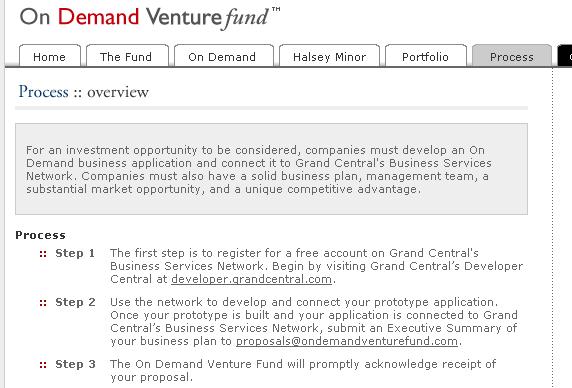
Step 1 - get a Grand Central account and build an application :-)
How subtle is that?
Step 1 - get a Grand Central account and build an application :-)
How subtle is that?
Saturday, October 30, 2004
The Importance of the Registry
Jeff Tonkel of Infravio recently pointed out the importance of the registry in a service oriented architecture. I'd like to second that thought. While I'm at it, I'll go so far as to state my opinion on who is leading in the space.
For starters, you have to look at BlueTitan. These guys get one real simple fact - you don't implement a registry for the sake of having a registry. Many vendors wrote a registry and encouraged their customers to dump crap in it. Bad idea. BlueTitan took the other approach - they started with the 'ilities' and worked backwards into the metadata that needed to be captured to manage a service network. Their registry is designed to capture only 'usable' metadata (actionable information); don't store anything that can't be used. Also they focused on the needs of enterprise grade service networks, the people with the really hard problems. I'm thrilled to see BlueTitan recognize that services are often just 'bumps on the network', that policies are 'service oriented aspects' and that the metadata and registry are the heart of making it functionally scalable. Most networks grow exponentially for some period of time; BlueTitan makes it possible to manage high growth networks on a linear cost scale.
After BlueTitan, you have to look at Systinet. Although these guys started with a strong UDDI slant, I believe they not only understand the limitations of UDDI, but are well on their way to overcoming the issues. I anticipate that Systinet will also have strong 'developer-side' integration into the registry (think reusable assets).
The registry is quickly turning into the 'metadata warehouse' - it is the point where a 'metadata driven architecture' and the 'service oriented architecture' merge. Architects are slowly figuring out that an important aspect of the SOA is the ability to factor the ilities out of applications. The registry is key to facilitating this movement.
For starters, you have to look at BlueTitan. These guys get one real simple fact - you don't implement a registry for the sake of having a registry. Many vendors wrote a registry and encouraged their customers to dump crap in it. Bad idea. BlueTitan took the other approach - they started with the 'ilities' and worked backwards into the metadata that needed to be captured to manage a service network. Their registry is designed to capture only 'usable' metadata (actionable information); don't store anything that can't be used. Also they focused on the needs of enterprise grade service networks, the people with the really hard problems. I'm thrilled to see BlueTitan recognize that services are often just 'bumps on the network', that policies are 'service oriented aspects' and that the metadata and registry are the heart of making it functionally scalable. Most networks grow exponentially for some period of time; BlueTitan makes it possible to manage high growth networks on a linear cost scale.
After BlueTitan, you have to look at Systinet. Although these guys started with a strong UDDI slant, I believe they not only understand the limitations of UDDI, but are well on their way to overcoming the issues. I anticipate that Systinet will also have strong 'developer-side' integration into the registry (think reusable assets).
The registry is quickly turning into the 'metadata warehouse' - it is the point where a 'metadata driven architecture' and the 'service oriented architecture' merge. Architects are slowly figuring out that an important aspect of the SOA is the ability to factor the ilities out of applications. The registry is key to facilitating this movement.
Friday, October 22, 2004
The AToM Splits Definition
The AToM, Anne Thomas Manes, took the time to mark up some definitions of SOA. I love it. Four things I'd change:
1. Services don't have to be 'autonomous'
2. Services don't have to be used for 'business'
3. In many cases services shouldn't be designed for 'reuse'
4. In many cases services won't be 'discovered'
Thus, try not to use those four words in the definition.
Posted on the soa news group...
===============================================
SearchWebServices asked this group of people to provide 50 word descriptions
of SOA. It's very hard to describe SOA in just 50 words (and obviously some
folks ignored the 50 word limit). You simply can't describe the tenets of
SOA so succinctly. Burton Group recently published a 22 page report
describing SOA, which I think does a much better job than any of these short
descriptions. I could easily write an entire book on the topic.
In my description, I endeavored to convey two of what I consider to be the
three major tenets of SOA: application factoring and abstraction, although I
was not able to convey the multiple aspects of these two tenets. I was also
not able to convey the third tenet: the requirement for standard protocols
for description, discovery, and communication.
Please see my comments below bracketed by ::atm::::/atm::.
-----Original Message-----
From: Gervas Douglas [mailto:gervasdouglas@yahoo.co.uk]
Sent: Thursday, October 21, 2004 12:53 PM
To: service-orientated-architecture@yahoogroups.com
Subject: [service-orientated-architecture] Re: Definition of SOA
Here are some definitions provided by SearchWebServices:
::::-------------------------------------------------------------------
-------------
"SOA is a framework enabling application functionality to be
provided, discovered and consumed as re-usable Web Services sets.
While Web Services do not equal SOA, it's one of the enabling
standards. SOA abstracts complexity and implementation details,
making it an ideal architectural mindset to leverage functionality
trapped within mainframe/midrange systems."
Scott Rosenbloom is chief strategist with WRQ Inc.
::atm:: SOA is an architecture -- not a framework. It is a style of design --
not a tool. On the other hand, "web services" is a framework -- a set of
tools (middleware) to help you implement applications and systems that
adhere to SOA design principles. (Although note that building applications
using the web services framework does not guarantee SOA.) SOA requires
standard protocols for description, discovery, and communication. The web
services framework standards define these standard protocols --
XMLSchema/WSDL, UDDI, and SOAP respectively, at a fundamental level,
although these core standards are not sufficient to support all SOA
requirements (secure, reliable, transacted applications supporting diverse
message exchange patterns) -- hence the ongoing effort to develop the WS-*
standards.
From my perspective, the best way to describe SOA is in terms of design
principles. Abstraction is one of the core tenets of SOA -- abstraction
between the interface and the implementation, and abstraction between
infrastructure and business logic. WSDL facilitates the first, and SOAP
facilitates the second. Another core tenet is proper application
functionality factoring. What granularity should a service have to best
enable reusability? I think this is the most challenging aspect of SOA. My
rule of thumb is that a service should represent a business task. But it's
hard to quantify this rule. ::/atm::
---------------------------------------------------------------------
-----------
"Secure, integrated delivery of IT solutions meeting business
requirements. Solutions must implement, optimize and guide business
process execution by combining the functionality of separate,
discreet, reusable services. SOA moves away from complex application
development, promoting a focus on standardizing interfaces between
atomic service components with centralized management and
distributed implementation."
Dave Morris, I.T. Security Lead TransAlta Corp.
::atm:: For the most part, I don't think this definition helps explain what
SOA means, but I like that fact that he associates SOA with "centralized
management and distributed implementation". As I said in my response to the
first definition, one of the core tenets of SOA is the requirement for
abstraction between infrastructure and business logic. Via the separation of
the SOAP Header from the SOAP Body, and via the requirements of the SOAP
processing model, SOAP enables the clean separation of infrastructure from
business logic. It permits developers to externalize most, if not all,
infrastructure functionality to the middleware. This feature enables
centralized management of the distributed implementation. ::/atm::
---------------------------------------------------------------------
-----------
"The SOA models the business as a collection of self-contained
services that are available across the enterprise that can be evoked
through standard protocols both internally and externally."
Dave McComb, president, Semantic Arts
::atm:: An accurate description, but it doesn't give you any real information
to work with. ::/atm::
---------------------------------------------------------------------
-----------
"Service Oriented Architecture is nothing but business oriented
architecture, which allows the flexibility of business applications,
to become independent but collaborative, while providing their
services. The applications under this architecture are both 'client'
and 'server' at the same time with freely available services."
Satheesan Kunnel, USWWI
::atm:: While it's definitely a brilliant idea to align IT with business, I
don't think this definition helps you figure out how to do so. ::/atm::
---------------------------------------------------------------------
-----------
"A service oriented architecture is an approach to design and
integrate software in a modular method where each module is
precisely a 'loosely coupled service' that is accessible over a
network and has the capability of being dynamically integrated with
other services at run time. A service must present a standard
Interface (be it WSDL today) for its functionality and invocation
methods while the real implementation of the service is not a
concern of an SOA."
Rajesh Dawar
::atm:: I like this definition, although I'd like to see a little more
definition of what a "precisely" loosely coupled service is. From my
perspective, the standard communication protocol has equal importance to the
standard description protocol, although this definition obviously gives more
weight to the description language. I also view XML Schema as equal weight
to WSDL. Again note that SOA does not require XML Schema, WSDL, and SOAP
specifically, but it does require that applications rely on a set of
standard protocols. When using web services to implement SOA, those standard
protocols are XML Schema, WSDL, and SOAP. ::/atm::
---------------------------------------------------------------------
-----------
"Services provide something of value to those who know how to
request and consume them, without having to know how to produce that
value. SOA is an approach to building software applications as
collections of autonomous services that interact without regard to
each other's platform, data structures, or internal algorithms."
Michael Champion, R&D specialist, Software AG
::atm:: Excellent short description! ::/atm::
---------------------------------------------------------------------
-----------
"A pattern of design, development, deployment, and management of (a)
applications and (b) software infrastructure and frameworks in
which:
Applications are organized into business units of work (services)
that are (typically) network accessible
Service interface definitions are first-class development artifacts
Quality of service (QoS) characteristics (security, transactions,
performance, etc.) are explicitly identified at design time
Software infrastructure takes active responsibility for managing QoS
and enforcing policy for service access and execution
Services and their metadata are cataloged in a repository
Protocols and structures within the architecture are, optionally,
based on industry standards (e.g., the emerging SOAP stack of
standards)
Randy Heffner, vice president, Forrester Research Inc.
::atm:: I have to question Randy's requirement that QoS characteristics must
be explicitly identified at design time. Perhaps he's talking about
composite application design time? -- the time when you are assembling
services? But even here I disagree. I contend that one of the most brilliant
features of SOAP and the web services framework is that it permits you to
externalize QoS functionality from the application so that it does not need
to be defined at service design time. Instead these requirements can and
should be specified at configuration time. QoS functionality can be
externalized from the application, specified via policies, and enforced
through the middleware. This is a required feature for reusability. The
security, reliability, transaction, and performance requirements of a
service may vary depending on how it is used in a particular composite
application or based on the specific client invoking the service. Rather
than hard-coding this complex functionality in the application, you can
configure the functionality using deployment and configuration wizards --
just tick the box to add security and reliability functionality. This
configuration process should generate a policy description (e.g.,
WS-Policy), which becomes part of the overall metadata/description contract
of the service (consisting of XML Schema, WSDL, WS-Policy, and potentially
other description languages).
Almost no one is using WS-Policy today, and I view it as one of the most
critical holes in the current web services framework. ::/atm::
---------------------------------------------------------------------
-----------
"SOA is a style of design that strives to enable easy integration
and flexible applications. In SOA, application functionality is
designed as shared reusable services. A service is a piece of
application functionality that exposes its functionality through an
abstract interface, which hides the inner workings of the service
implementation."
Anne Thomas Manes, analyst, Burton Group
---------------------------------------------------------------------
-----------
"An SOA is an enterprise-scale architecture (typically spanning
multiple applications within an enterprise or across multiple
enterprises) where the primary structuring element is a service (as
opposed to modules, systems, applications or components).
A service is a set of related business functions that are interacted
with locally or remotely using a message-passing/document-oriented
communication style. A service is composed of (1) a (functional)
service interface and (2) a service implementation that implements
one or more service interfaces and adheres to a certain set of (non-
functional) capabilities. Specific services are defined in terms of
the transport/application/messaging protocol, not in terms of a
specific programming model.
An SOA will typically include technical services to manage metadata
about service interfaces and implementations, service providers and
service consumers; and services for managing and enforcing policies,
access control, security features, and transactions, although all of
these are optional within any specific SOA instance."
Stefan Tilkov, CEO, innoQ
::atm:: Excellent description! (although Stefan obviously exceeded the 50 word
maximum) ::/atm::
---------------------------------------------------------------------
-----------
"Service-oriented architecture is an architectural discipline that
centers on the notion that IT assets are described and exposed as
Services. These Services can then be composed in a loosely-coupled
fashion into higher-level business processes, which providing
business agility in the face of IT heterogeneity."
Ronald Schmelzer, analyst, ZapThink LLC
::atm:: Excellent description! ::/atm::
---------------------------------------------------------------------
-----------
"Service Oriented Architecture (SOA) is an approach to the
development of loosely coupled, protocol-independent distributed
applications composed from well-defined, self-contained software
resources accessible as Services across the extended enterprise in a
standardized way, enhancing re-usability and interoperability."
Ankur Gupta, marketing manager, Fiorano Software Inc.
::atm:: Good description, although hard to parse. ::/atm::
1. Services don't have to be 'autonomous'
2. Services don't have to be used for 'business'
3. In many cases services shouldn't be designed for 'reuse'
4. In many cases services won't be 'discovered'
Thus, try not to use those four words in the definition.
Posted on the soa news group...
===============================================
SearchWebServices asked this group of people to provide 50 word descriptions
of SOA. It's very hard to describe SOA in just 50 words (and obviously some
folks ignored the 50 word limit). You simply can't describe the tenets of
SOA so succinctly. Burton Group recently published a 22 page report
describing SOA, which I think does a much better job than any of these short
descriptions. I could easily write an entire book on the topic.
In my description, I endeavored to convey two of what I consider to be the
three major tenets of SOA: application factoring and abstraction, although I
was not able to convey the multiple aspects of these two tenets. I was also
not able to convey the third tenet: the requirement for standard protocols
for description, discovery, and communication.
Please see my comments below bracketed by ::atm::::/atm::.
-----Original Message-----
From: Gervas Douglas [mailto:gervasdouglas@yahoo.co.uk]
Sent: Thursday, October 21, 2004 12:53 PM
To: service-orientated-architecture@yahoogroups.com
Subject: [service-orientated-architecture] Re: Definition of SOA
Here are some definitions provided by SearchWebServices:
::::-------------------------------------------------------------------
-------------
"SOA is a framework enabling application functionality to be
provided, discovered and consumed as re-usable Web Services sets.
While Web Services do not equal SOA, it's one of the enabling
standards. SOA abstracts complexity and implementation details,
making it an ideal architectural mindset to leverage functionality
trapped within mainframe/midrange systems."
Scott Rosenbloom is chief strategist with WRQ Inc.
::atm:: SOA is an architecture -- not a framework. It is a style of design --
not a tool. On the other hand, "web services" is a framework -- a set of
tools (middleware) to help you implement applications and systems that
adhere to SOA design principles. (Although note that building applications
using the web services framework does not guarantee SOA.) SOA requires
standard protocols for description, discovery, and communication. The web
services framework standards define these standard protocols --
XMLSchema/WSDL, UDDI, and SOAP respectively, at a fundamental level,
although these core standards are not sufficient to support all SOA
requirements (secure, reliable, transacted applications supporting diverse
message exchange patterns) -- hence the ongoing effort to develop the WS-*
standards.
From my perspective, the best way to describe SOA is in terms of design
principles. Abstraction is one of the core tenets of SOA -- abstraction
between the interface and the implementation, and abstraction between
infrastructure and business logic. WSDL facilitates the first, and SOAP
facilitates the second. Another core tenet is proper application
functionality factoring. What granularity should a service have to best
enable reusability? I think this is the most challenging aspect of SOA. My
rule of thumb is that a service should represent a business task. But it's
hard to quantify this rule. ::/atm::
---------------------------------------------------------------------
-----------
"Secure, integrated delivery of IT solutions meeting business
requirements. Solutions must implement, optimize and guide business
process execution by combining the functionality of separate,
discreet, reusable services. SOA moves away from complex application
development, promoting a focus on standardizing interfaces between
atomic service components with centralized management and
distributed implementation."
Dave Morris, I.T. Security Lead TransAlta Corp.
::atm:: For the most part, I don't think this definition helps explain what
SOA means, but I like that fact that he associates SOA with "centralized
management and distributed implementation". As I said in my response to the
first definition, one of the core tenets of SOA is the requirement for
abstraction between infrastructure and business logic. Via the separation of
the SOAP Header from the SOAP Body, and via the requirements of the SOAP
processing model, SOAP enables the clean separation of infrastructure from
business logic. It permits developers to externalize most, if not all,
infrastructure functionality to the middleware. This feature enables
centralized management of the distributed implementation. ::/atm::
---------------------------------------------------------------------
-----------
"The SOA models the business as a collection of self-contained
services that are available across the enterprise that can be evoked
through standard protocols both internally and externally."
Dave McComb, president, Semantic Arts
::atm:: An accurate description, but it doesn't give you any real information
to work with. ::/atm::
---------------------------------------------------------------------
-----------
"Service Oriented Architecture is nothing but business oriented
architecture, which allows the flexibility of business applications,
to become independent but collaborative, while providing their
services. The applications under this architecture are both 'client'
and 'server' at the same time with freely available services."
Satheesan Kunnel, USWWI
::atm:: While it's definitely a brilliant idea to align IT with business, I
don't think this definition helps you figure out how to do so. ::/atm::
---------------------------------------------------------------------
-----------
"A service oriented architecture is an approach to design and
integrate software in a modular method where each module is
precisely a 'loosely coupled service' that is accessible over a
network and has the capability of being dynamically integrated with
other services at run time. A service must present a standard
Interface (be it WSDL today) for its functionality and invocation
methods while the real implementation of the service is not a
concern of an SOA."
Rajesh Dawar
::atm:: I like this definition, although I'd like to see a little more
definition of what a "precisely" loosely coupled service is. From my
perspective, the standard communication protocol has equal importance to the
standard description protocol, although this definition obviously gives more
weight to the description language. I also view XML Schema as equal weight
to WSDL. Again note that SOA does not require XML Schema, WSDL, and SOAP
specifically, but it does require that applications rely on a set of
standard protocols. When using web services to implement SOA, those standard
protocols are XML Schema, WSDL, and SOAP. ::/atm::
---------------------------------------------------------------------
-----------
"Services provide something of value to those who know how to
request and consume them, without having to know how to produce that
value. SOA is an approach to building software applications as
collections of autonomous services that interact without regard to
each other's platform, data structures, or internal algorithms."
Michael Champion, R&D specialist, Software AG
::atm:: Excellent short description! ::/atm::
---------------------------------------------------------------------
-----------
"A pattern of design, development, deployment, and management of (a)
applications and (b) software infrastructure and frameworks in
which:
Applications are organized into business units of work (services)
that are (typically) network accessible
Service interface definitions are first-class development artifacts
Quality of service (QoS) characteristics (security, transactions,
performance, etc.) are explicitly identified at design time
Software infrastructure takes active responsibility for managing QoS
and enforcing policy for service access and execution
Services and their metadata are cataloged in a repository
Protocols and structures within the architecture are, optionally,
based on industry standards (e.g., the emerging SOAP stack of
standards)
Randy Heffner, vice president, Forrester Research Inc.
::atm:: I have to question Randy's requirement that QoS characteristics must
be explicitly identified at design time. Perhaps he's talking about
composite application design time? -- the time when you are assembling
services? But even here I disagree. I contend that one of the most brilliant
features of SOAP and the web services framework is that it permits you to
externalize QoS functionality from the application so that it does not need
to be defined at service design time. Instead these requirements can and
should be specified at configuration time. QoS functionality can be
externalized from the application, specified via policies, and enforced
through the middleware. This is a required feature for reusability. The
security, reliability, transaction, and performance requirements of a
service may vary depending on how it is used in a particular composite
application or based on the specific client invoking the service. Rather
than hard-coding this complex functionality in the application, you can
configure the functionality using deployment and configuration wizards --
just tick the box to add security and reliability functionality. This
configuration process should generate a policy description (e.g.,
WS-Policy), which becomes part of the overall metadata/description contract
of the service (consisting of XML Schema, WSDL, WS-Policy, and potentially
other description languages).
Almost no one is using WS-Policy today, and I view it as one of the most
critical holes in the current web services framework. ::/atm::
---------------------------------------------------------------------
-----------
"SOA is a style of design that strives to enable easy integration
and flexible applications. In SOA, application functionality is
designed as shared reusable services. A service is a piece of
application functionality that exposes its functionality through an
abstract interface, which hides the inner workings of the service
implementation."
Anne Thomas Manes, analyst, Burton Group
---------------------------------------------------------------------
-----------
"An SOA is an enterprise-scale architecture (typically spanning
multiple applications within an enterprise or across multiple
enterprises) where the primary structuring element is a service (as
opposed to modules, systems, applications or components).
A service is a set of related business functions that are interacted
with locally or remotely using a message-passing/document-oriented
communication style. A service is composed of (1) a (functional)
service interface and (2) a service implementation that implements
one or more service interfaces and adheres to a certain set of (non-
functional) capabilities. Specific services are defined in terms of
the transport/application/messaging protocol, not in terms of a
specific programming model.
An SOA will typically include technical services to manage metadata
about service interfaces and implementations, service providers and
service consumers; and services for managing and enforcing policies,
access control, security features, and transactions, although all of
these are optional within any specific SOA instance."
Stefan Tilkov, CEO, innoQ
::atm:: Excellent description! (although Stefan obviously exceeded the 50 word
maximum) ::/atm::
---------------------------------------------------------------------
-----------
"Service-oriented architecture is an architectural discipline that
centers on the notion that IT assets are described and exposed as
Services. These Services can then be composed in a loosely-coupled
fashion into higher-level business processes, which providing
business agility in the face of IT heterogeneity."
Ronald Schmelzer, analyst, ZapThink LLC
::atm:: Excellent description! ::/atm::
---------------------------------------------------------------------
-----------
"Service Oriented Architecture (SOA) is an approach to the
development of loosely coupled, protocol-independent distributed
applications composed from well-defined, self-contained software
resources accessible as Services across the extended enterprise in a
standardized way, enhancing re-usability and interoperability."
Ankur Gupta, marketing manager, Fiorano Software Inc.
::atm:: Good description, although hard to parse. ::/atm::
Subscribe to:
Posts (Atom)