The Microsoft Patterns & Practices group released a set of SOA principles. I was eager to see what the brains came up with but found myself beyond disappointed; I found myself actually in awe of their incompetence. Perhaps these are tough words but I'm so extremely disappointed in the group-think that is currently going on in the SOA world that I feel compelled to point it out.
First, the show can be found here:
http://msevents.microsoft.com/cui/WebCastEventDetails.aspx?culture=en-US&EventID=1032262538&CountryCode=US
MS stated four primary tenets to SOA. My first thought was "holy smokes, they got it down to four?!!!" Well, here they are:
1. Boundaries are explicit
2. Services are autonomous
3. Services share schema and contract, not class
4. Service compatibility is based on policy
Boundaries are explicit - yep, hard to argue. But what does this actually say? How about this instead: "All exchanges of data, metadata, logic or other binary asset MUST BE exchanged through a contract. Runtime changes to code dependencies are NOT allowed."
Services are autonomous - Most people know that I firmly believe that "services are not autonomous", they are synergistic. Services work together in a 'service ecosystem'. Services will influence each others metadata. In no way are services autonomous.
Services share schema and contract, not class - I believe the point is that you want to share data using self describing, self validating, extensible schema systems that are ubiquitously deployed. That's cool - use an abstract typing system.
Service compatibility is based on policy - Yes. Agreed.
The patterns group then identified some "anti-patterns" or things not to do:
1. Avoid CRUDy interfaces. Don't use the CRUD pattern.
Guys - this is so wrong I felt sorry for them. After listening to them babble on this for a while all credibility was lost. I think what they meant to say is "Use CRUD, but don't violate the age-old wisdom around fully encapsulating and abstracting the persistence mechanisms. "
The second anti-pattern was avoid "loosely goosey" interfaces. The example they used was something like "runQuery(qry)". This one is tougher. If you really don't know what query combination needs to be run at design time then... you pretty much need something like "runQuery(qry)". This gets into a real interesting space that I wish MS would have talked about. Is it ok to pass XPath statement? Is it ok to pass an XQuery command? What is the right way to solve the runtime predicate problem? Surely the answer isn't "don't solve it". What about the surrogate key problem - where the only primary key is vendor specific key?
The list goes on and on... MS has the brains to do this stuff right. I wish they would ask some of their smart people to help the patterns & practice group get this stuff right.
Tuesday, November 30, 2004

Tuesday, November 23, 2004
Languages are Less Important
"Languages are Less Important" is one of the simple philosophies in Awesome(tm):
Traditionally, the choice of programming languages in an I.T. department was a near-religous decision. One reason was that the language tended to slither its way from one application to the next. Knowing this, managers would be very careful about allowing a new language into a development shop. In addition, reuse was considered a language specific mining activity (no one tried to pull Java code out of one application and put it in a Perl application). On top of this was the obvious fact that all of the enterprise API's were language specific, including J2EE and .Net.
Enterprises that implement Contract First Design and believe that Platforms are Contract Driven are much less dependent on specific languages or language specific libraries. Now, with this said - languages are still important for some real good reasons including: Developers skilled in one language shouldn't have to learn a new language for every different service they run into. Most I.T. shops already have large investments in platform specific code bases that they will want to leverage.
Although languages are less important in a service oriented world, they are still important. As services become more popular it will be common to find languages which are more friendly towards service development. This may be based on their ability to work with the Web Service standards, to expose themselves as a service or to invoke a service.
Well, it seems as though Peter Yared understood this some time back. Unlike the scores of startups that re-create the same damn product using all the same damn technologies... ActiveGrid made a hard left turn. The company appears to have come to the obvious realizations that no one else seems to have the guts to admit:
1. J2EE is a bloated set of deprecated patches.
2. Static Java objects and dynamic XML collide
3. Contract first programming make "languages less important"
4. If you're in an SO world, you might as well pick an SO friendly language
5. J2EE was designed to scale across a VM that sits on a multi-CPU box
6. Oh, Sun owns Java and J2EE, and what do you know... they sell multi-CPU boxes
7. Rip & replace Intel/AMD/Linux boxes are fast, cheap and reliable
8. LAMP is here to stay.
9. The growth rate of transactions inside an enterprise is significant.
10. The last-gen computing method will hit an 'economic breaking point'.
ActiveGrid is a "market starter"; the door has just been opened to commoditize the OS, the language and the vm while kicking big boxes in the groin and enabling service developers to be more productive while offering a lower cost of computing. Interesting? Uh, yes.
Traditionally, the choice of programming languages in an I.T. department was a near-religous decision. One reason was that the language tended to slither its way from one application to the next. Knowing this, managers would be very careful about allowing a new language into a development shop. In addition, reuse was considered a language specific mining activity (no one tried to pull Java code out of one application and put it in a Perl application). On top of this was the obvious fact that all of the enterprise API's were language specific, including J2EE and .Net.
Enterprises that implement Contract First Design and believe that Platforms are Contract Driven are much less dependent on specific languages or language specific libraries. Now, with this said - languages are still important for some real good reasons including: Developers skilled in one language shouldn't have to learn a new language for every different service they run into. Most I.T. shops already have large investments in platform specific code bases that they will want to leverage.
Although languages are less important in a service oriented world, they are still important. As services become more popular it will be common to find languages which are more friendly towards service development. This may be based on their ability to work with the Web Service standards, to expose themselves as a service or to invoke a service.
Well, it seems as though Peter Yared understood this some time back. Unlike the scores of startups that re-create the same damn product using all the same damn technologies... ActiveGrid made a hard left turn. The company appears to have come to the obvious realizations that no one else seems to have the guts to admit:
1. J2EE is a bloated set of deprecated patches.
2. Static Java objects and dynamic XML collide
3. Contract first programming make "languages less important"
4. If you're in an SO world, you might as well pick an SO friendly language
5. J2EE was designed to scale across a VM that sits on a multi-CPU box
6. Oh, Sun owns Java and J2EE, and what do you know... they sell multi-CPU boxes
7. Rip & replace Intel/AMD/Linux boxes are fast, cheap and reliable
8. LAMP is here to stay.
9. The growth rate of transactions inside an enterprise is significant.
10. The last-gen computing method will hit an 'economic breaking point'.
ActiveGrid is a "market starter"; the door has just been opened to commoditize the OS, the language and the vm while kicking big boxes in the groin and enabling service developers to be more productive while offering a lower cost of computing. Interesting? Uh, yes.
Friday, November 19, 2004
"Design by Contract" or "Contract First"?
I'm trying to clean up some terminology that I've been using in the Awesome(tm) method. The latest is the term "design by contract(tm)". This is a term that Bertrand Meyer coined (and trademarked). He used it in the context of object oriented programming where the focus was on "pre- and post-conditions and class invariants".
Don Box, Christian Weyer and others have favored the term "contract first" to describe a similar concept more suitable to web services. Here the focus has been on giving a service the ability to advertise:
- Type definitions
- Message definitions
- Operations (inbound and outbound)
- Message Exchange Patterns (e.g., request/response)
- Interfaces (groups of operations)
- Bindings
However, it is apparent that the contract goes beyond the basic wsdl stuff. It must also include:
- Pre-conditions / post-condition assertions
- Non-functional policies (security, reliability, transactional integrity)
- Hosted service level agreements (availability, latency)
- Synchronicity capabilities (asynch, synch or bi-synch)
Eventually the contracts will include stuff like:
- Semantic ontology (or other semantic broker)
- Costing /recharge functions
- Estimates to run service (think big-O)
- Preferred translator service (don't understand SOAP 1.5, but do understand SOAP 1.3)
- Code mobility agreements
- Service-to-service automated recompilation agreements (HotSpot for SO)
- Service dependencies (other services and resources)
(many of these will show up as standardized interfaces implemented by a service container)
I guess what I'm saying is that "design by contract" doesn't mean the same thing that we are talking about in the service oriented world. Hence, "Contract First" it is!
-----
Here's one to ponder... what pieces of the contract should be in a document format (like WSDL) versus in an interface format (like ws-mex). Or should they be in both? Why doesn't WSDL have a WSDL interface: getOperations()?? Is the ws-mex, getMetadata() the right way to go? Or should you look at it as an enterprise vocabulary problem? "GET" + "OPERATION" (think ws-transfer). Or is it a semantic ontology problem where you have "GET" and a pre-condition stating you can only get things that 'are a kind of' "METADATA"... Well, doesn't really matter - looks like we will have every combination possible. :-)
Don Box, Christian Weyer and others have favored the term "contract first" to describe a similar concept more suitable to web services. Here the focus has been on giving a service the ability to advertise:
- Type definitions
- Message definitions
- Operations (inbound and outbound)
- Message Exchange Patterns (e.g., request/response)
- Interfaces (groups of operations)
- Bindings
However, it is apparent that the contract goes beyond the basic wsdl stuff. It must also include:
- Pre-conditions / post-condition assertions
- Non-functional policies (security, reliability, transactional integrity)
- Hosted service level agreements (availability, latency)
- Synchronicity capabilities (asynch, synch or bi-synch)
Eventually the contracts will include stuff like:
- Semantic ontology (or other semantic broker)
- Costing /recharge functions
- Estimates to run service (think big-O)
- Preferred translator service (don't understand SOAP 1.5, but do understand SOAP 1.3)
- Code mobility agreements
- Service-to-service automated recompilation agreements (HotSpot for SO)
- Service dependencies (other services and resources)
(many of these will show up as standardized interfaces implemented by a service container)
I guess what I'm saying is that "design by contract" doesn't mean the same thing that we are talking about in the service oriented world. Hence, "Contract First" it is!
-----
Here's one to ponder... what pieces of the contract should be in a document format (like WSDL) versus in an interface format (like ws-mex). Or should they be in both? Why doesn't WSDL have a WSDL interface: getOperations()?? Is the ws-mex, getMetadata() the right way to go? Or should you look at it as an enterprise vocabulary problem? "GET" + "OPERATION" (think ws-transfer). Or is it a semantic ontology problem where you have "GET" and a pre-condition stating you can only get things that 'are a kind of' "METADATA"... Well, doesn't really matter - looks like we will have every combination possible. :-)
Thursday, November 18, 2004
One of my favorites...
One of my favorite posts:
http://schneider.blogspot.com/2002_12_01_schneider_archive.html#90283350
(still waiting).
http://schneider.blogspot.com/2002_12_01_schneider_archive.html#90283350
(still waiting).
Saturday, November 13, 2004
Service Oriented Methodology
In 1998, a few of us at Momentum (James Higginbotham, Mark Spitzer, Ed French) wrote a software development method that we called Reality(tm). The method borrowed from best practices of Booch, Rumbaugh, Jacobson, Coad-Yourdan and Schaler-Mellor. Later we incorporated UML and concepts from Extreme Programming. We also threw in platform specific (Java & .Net) best practice guides and reference architectures. The Reality method has served us on over 100 engagements. I'll admit that we haven't always follow it to the letter of the law, but the intent seems to find its way into all of the projects.
However, at the heart of Reality is an "object oriented" development cycle. We were so heavily influenced by the "object people" that many of the mandatory artifacts and diagrams are OO in nature. Anyone that remotely knows me, knows that for the last half-decade I've been exclusively focused on service oriented computing. And for the last half-decade I've been waiting for a "service oriented" method.
Well - we decided to bite the bullet and start knocking one out. We are currently calling the skunk-works project "Awesome!(tm)" (Advanced Web Service Oriented Method) but my marketing team is telling me, "the name has got to go". I'm open.
The Awesome! method revisits a handful of concepts:
- Service centric diagrams & modeling notation
- Service centric artifacts
- Service network artifacts
- "contract first" development lifecycle
- Service level agreements as a first order concept
- Business process 'binds' to service networks
We also have started a repository of best practices - however these seem to have a half-life of about 10 months.
In 2005, we expect a half dozen SO-methods to come out - we know, this isn't exactly a new concept. As others come out, we plan on learning and upgrading our own. We figure it will take about 3 or 4 years before the SO-Methods come together with a set of base features and common notation. We also believe that people will want more than the "Microsoft Method" - and that choice is good.
Unlike our Reality method, Awesome! will be made publicly available. We aren't quite ready to share it with the public yet but are eliciting ideas on what people want in an SO-Method (email me). After the straw-man is together, we'll drop it out for public review and begin the upgrade cycle. Let me know if you have an interest in being an active contributor.
Methods are repeatable processes. They enable companies to reduce risk around projects and to leverage resources by assigning them to well-defined tasks. As service oriented styles move into the enterprise, the use of SO-Methods to complement your existing methods (RUP/UML, etc.) will be common. We need to move SO from an art to a science (or at least a craft) - and soon.
However, at the heart of Reality is an "object oriented" development cycle. We were so heavily influenced by the "object people" that many of the mandatory artifacts and diagrams are OO in nature. Anyone that remotely knows me, knows that for the last half-decade I've been exclusively focused on service oriented computing. And for the last half-decade I've been waiting for a "service oriented" method.
Well - we decided to bite the bullet and start knocking one out. We are currently calling the skunk-works project "Awesome!(tm)" (Advanced Web Service Oriented Method) but my marketing team is telling me, "the name has got to go". I'm open.
The Awesome! method revisits a handful of concepts:
- Service centric diagrams & modeling notation
- Service centric artifacts
- Service network artifacts
- "contract first" development lifecycle
- Service level agreements as a first order concept
- Business process 'binds' to service networks
We also have started a repository of best practices - however these seem to have a half-life of about 10 months.
In 2005, we expect a half dozen SO-methods to come out - we know, this isn't exactly a new concept. As others come out, we plan on learning and upgrading our own. We figure it will take about 3 or 4 years before the SO-Methods come together with a set of base features and common notation. We also believe that people will want more than the "Microsoft Method" - and that choice is good.
Unlike our Reality method, Awesome! will be made publicly available. We aren't quite ready to share it with the public yet but are eliciting ideas on what people want in an SO-Method (email me). After the straw-man is together, we'll drop it out for public review and begin the upgrade cycle. Let me know if you have an interest in being an active contributor.
Methods are repeatable processes. They enable companies to reduce risk around projects and to leverage resources by assigning them to well-defined tasks. As service oriented styles move into the enterprise, the use of SO-Methods to complement your existing methods (RUP/UML, etc.) will be common. We need to move SO from an art to a science (or at least a craft) - and soon.
Sunday, November 07, 2004
On Grand Venture Fund
Take a look at the application form for receiving venture funding from the On Demand Venture Fund:
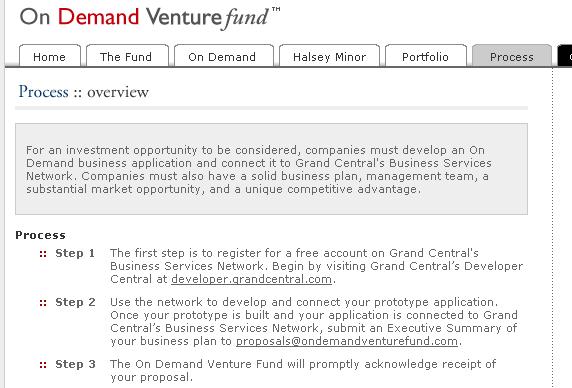
Step 1 - get a Grand Central account and build an application :-)
How subtle is that?
Step 1 - get a Grand Central account and build an application :-)
How subtle is that?
Saturday, October 30, 2004
The Importance of the Registry
Jeff Tonkel of Infravio recently pointed out the importance of the registry in a service oriented architecture. I'd like to second that thought. While I'm at it, I'll go so far as to state my opinion on who is leading in the space.
For starters, you have to look at BlueTitan. These guys get one real simple fact - you don't implement a registry for the sake of having a registry. Many vendors wrote a registry and encouraged their customers to dump crap in it. Bad idea. BlueTitan took the other approach - they started with the 'ilities' and worked backwards into the metadata that needed to be captured to manage a service network. Their registry is designed to capture only 'usable' metadata (actionable information); don't store anything that can't be used. Also they focused on the needs of enterprise grade service networks, the people with the really hard problems. I'm thrilled to see BlueTitan recognize that services are often just 'bumps on the network', that policies are 'service oriented aspects' and that the metadata and registry are the heart of making it functionally scalable. Most networks grow exponentially for some period of time; BlueTitan makes it possible to manage high growth networks on a linear cost scale.
After BlueTitan, you have to look at Systinet. Although these guys started with a strong UDDI slant, I believe they not only understand the limitations of UDDI, but are well on their way to overcoming the issues. I anticipate that Systinet will also have strong 'developer-side' integration into the registry (think reusable assets).
The registry is quickly turning into the 'metadata warehouse' - it is the point where a 'metadata driven architecture' and the 'service oriented architecture' merge. Architects are slowly figuring out that an important aspect of the SOA is the ability to factor the ilities out of applications. The registry is key to facilitating this movement.
For starters, you have to look at BlueTitan. These guys get one real simple fact - you don't implement a registry for the sake of having a registry. Many vendors wrote a registry and encouraged their customers to dump crap in it. Bad idea. BlueTitan took the other approach - they started with the 'ilities' and worked backwards into the metadata that needed to be captured to manage a service network. Their registry is designed to capture only 'usable' metadata (actionable information); don't store anything that can't be used. Also they focused on the needs of enterprise grade service networks, the people with the really hard problems. I'm thrilled to see BlueTitan recognize that services are often just 'bumps on the network', that policies are 'service oriented aspects' and that the metadata and registry are the heart of making it functionally scalable. Most networks grow exponentially for some period of time; BlueTitan makes it possible to manage high growth networks on a linear cost scale.
After BlueTitan, you have to look at Systinet. Although these guys started with a strong UDDI slant, I believe they not only understand the limitations of UDDI, but are well on their way to overcoming the issues. I anticipate that Systinet will also have strong 'developer-side' integration into the registry (think reusable assets).
The registry is quickly turning into the 'metadata warehouse' - it is the point where a 'metadata driven architecture' and the 'service oriented architecture' merge. Architects are slowly figuring out that an important aspect of the SOA is the ability to factor the ilities out of applications. The registry is key to facilitating this movement.
Friday, October 22, 2004
The AToM Splits Definition
The AToM, Anne Thomas Manes, took the time to mark up some definitions of SOA. I love it. Four things I'd change:
1. Services don't have to be 'autonomous'
2. Services don't have to be used for 'business'
3. In many cases services shouldn't be designed for 'reuse'
4. In many cases services won't be 'discovered'
Thus, try not to use those four words in the definition.
Posted on the soa news group...
===============================================
SearchWebServices asked this group of people to provide 50 word descriptions
of SOA. It's very hard to describe SOA in just 50 words (and obviously some
folks ignored the 50 word limit). You simply can't describe the tenets of
SOA so succinctly. Burton Group recently published a 22 page report
describing SOA, which I think does a much better job than any of these short
descriptions. I could easily write an entire book on the topic.
In my description, I endeavored to convey two of what I consider to be the
three major tenets of SOA: application factoring and abstraction, although I
was not able to convey the multiple aspects of these two tenets. I was also
not able to convey the third tenet: the requirement for standard protocols
for description, discovery, and communication.
Please see my comments below bracketed by ::atm::::/atm::.
-----Original Message-----
From: Gervas Douglas [mailto:gervasdouglas@yahoo.co.uk]
Sent: Thursday, October 21, 2004 12:53 PM
To: service-orientated-architecture@yahoogroups.com
Subject: [service-orientated-architecture] Re: Definition of SOA
Here are some definitions provided by SearchWebServices:
::::-------------------------------------------------------------------
-------------
"SOA is a framework enabling application functionality to be
provided, discovered and consumed as re-usable Web Services sets.
While Web Services do not equal SOA, it's one of the enabling
standards. SOA abstracts complexity and implementation details,
making it an ideal architectural mindset to leverage functionality
trapped within mainframe/midrange systems."
Scott Rosenbloom is chief strategist with WRQ Inc.
::atm:: SOA is an architecture -- not a framework. It is a style of design --
not a tool. On the other hand, "web services" is a framework -- a set of
tools (middleware) to help you implement applications and systems that
adhere to SOA design principles. (Although note that building applications
using the web services framework does not guarantee SOA.) SOA requires
standard protocols for description, discovery, and communication. The web
services framework standards define these standard protocols --
XMLSchema/WSDL, UDDI, and SOAP respectively, at a fundamental level,
although these core standards are not sufficient to support all SOA
requirements (secure, reliable, transacted applications supporting diverse
message exchange patterns) -- hence the ongoing effort to develop the WS-*
standards.
From my perspective, the best way to describe SOA is in terms of design
principles. Abstraction is one of the core tenets of SOA -- abstraction
between the interface and the implementation, and abstraction between
infrastructure and business logic. WSDL facilitates the first, and SOAP
facilitates the second. Another core tenet is proper application
functionality factoring. What granularity should a service have to best
enable reusability? I think this is the most challenging aspect of SOA. My
rule of thumb is that a service should represent a business task. But it's
hard to quantify this rule. ::/atm::
---------------------------------------------------------------------
-----------
"Secure, integrated delivery of IT solutions meeting business
requirements. Solutions must implement, optimize and guide business
process execution by combining the functionality of separate,
discreet, reusable services. SOA moves away from complex application
development, promoting a focus on standardizing interfaces between
atomic service components with centralized management and
distributed implementation."
Dave Morris, I.T. Security Lead TransAlta Corp.
::atm:: For the most part, I don't think this definition helps explain what
SOA means, but I like that fact that he associates SOA with "centralized
management and distributed implementation". As I said in my response to the
first definition, one of the core tenets of SOA is the requirement for
abstraction between infrastructure and business logic. Via the separation of
the SOAP Header from the SOAP Body, and via the requirements of the SOAP
processing model, SOAP enables the clean separation of infrastructure from
business logic. It permits developers to externalize most, if not all,
infrastructure functionality to the middleware. This feature enables
centralized management of the distributed implementation. ::/atm::
---------------------------------------------------------------------
-----------
"The SOA models the business as a collection of self-contained
services that are available across the enterprise that can be evoked
through standard protocols both internally and externally."
Dave McComb, president, Semantic Arts
::atm:: An accurate description, but it doesn't give you any real information
to work with. ::/atm::
---------------------------------------------------------------------
-----------
"Service Oriented Architecture is nothing but business oriented
architecture, which allows the flexibility of business applications,
to become independent but collaborative, while providing their
services. The applications under this architecture are both 'client'
and 'server' at the same time with freely available services."
Satheesan Kunnel, USWWI
::atm:: While it's definitely a brilliant idea to align IT with business, I
don't think this definition helps you figure out how to do so. ::/atm::
---------------------------------------------------------------------
-----------
"A service oriented architecture is an approach to design and
integrate software in a modular method where each module is
precisely a 'loosely coupled service' that is accessible over a
network and has the capability of being dynamically integrated with
other services at run time. A service must present a standard
Interface (be it WSDL today) for its functionality and invocation
methods while the real implementation of the service is not a
concern of an SOA."
Rajesh Dawar
::atm:: I like this definition, although I'd like to see a little more
definition of what a "precisely" loosely coupled service is. From my
perspective, the standard communication protocol has equal importance to the
standard description protocol, although this definition obviously gives more
weight to the description language. I also view XML Schema as equal weight
to WSDL. Again note that SOA does not require XML Schema, WSDL, and SOAP
specifically, but it does require that applications rely on a set of
standard protocols. When using web services to implement SOA, those standard
protocols are XML Schema, WSDL, and SOAP. ::/atm::
---------------------------------------------------------------------
-----------
"Services provide something of value to those who know how to
request and consume them, without having to know how to produce that
value. SOA is an approach to building software applications as
collections of autonomous services that interact without regard to
each other's platform, data structures, or internal algorithms."
Michael Champion, R&D specialist, Software AG
::atm:: Excellent short description! ::/atm::
---------------------------------------------------------------------
-----------
"A pattern of design, development, deployment, and management of (a)
applications and (b) software infrastructure and frameworks in
which:
Applications are organized into business units of work (services)
that are (typically) network accessible
Service interface definitions are first-class development artifacts
Quality of service (QoS) characteristics (security, transactions,
performance, etc.) are explicitly identified at design time
Software infrastructure takes active responsibility for managing QoS
and enforcing policy for service access and execution
Services and their metadata are cataloged in a repository
Protocols and structures within the architecture are, optionally,
based on industry standards (e.g., the emerging SOAP stack of
standards)
Randy Heffner, vice president, Forrester Research Inc.
::atm:: I have to question Randy's requirement that QoS characteristics must
be explicitly identified at design time. Perhaps he's talking about
composite application design time? -- the time when you are assembling
services? But even here I disagree. I contend that one of the most brilliant
features of SOAP and the web services framework is that it permits you to
externalize QoS functionality from the application so that it does not need
to be defined at service design time. Instead these requirements can and
should be specified at configuration time. QoS functionality can be
externalized from the application, specified via policies, and enforced
through the middleware. This is a required feature for reusability. The
security, reliability, transaction, and performance requirements of a
service may vary depending on how it is used in a particular composite
application or based on the specific client invoking the service. Rather
than hard-coding this complex functionality in the application, you can
configure the functionality using deployment and configuration wizards --
just tick the box to add security and reliability functionality. This
configuration process should generate a policy description (e.g.,
WS-Policy), which becomes part of the overall metadata/description contract
of the service (consisting of XML Schema, WSDL, WS-Policy, and potentially
other description languages).
Almost no one is using WS-Policy today, and I view it as one of the most
critical holes in the current web services framework. ::/atm::
---------------------------------------------------------------------
-----------
"SOA is a style of design that strives to enable easy integration
and flexible applications. In SOA, application functionality is
designed as shared reusable services. A service is a piece of
application functionality that exposes its functionality through an
abstract interface, which hides the inner workings of the service
implementation."
Anne Thomas Manes, analyst, Burton Group
---------------------------------------------------------------------
-----------
"An SOA is an enterprise-scale architecture (typically spanning
multiple applications within an enterprise or across multiple
enterprises) where the primary structuring element is a service (as
opposed to modules, systems, applications or components).
A service is a set of related business functions that are interacted
with locally or remotely using a message-passing/document-oriented
communication style. A service is composed of (1) a (functional)
service interface and (2) a service implementation that implements
one or more service interfaces and adheres to a certain set of (non-
functional) capabilities. Specific services are defined in terms of
the transport/application/messaging protocol, not in terms of a
specific programming model.
An SOA will typically include technical services to manage metadata
about service interfaces and implementations, service providers and
service consumers; and services for managing and enforcing policies,
access control, security features, and transactions, although all of
these are optional within any specific SOA instance."
Stefan Tilkov, CEO, innoQ
::atm:: Excellent description! (although Stefan obviously exceeded the 50 word
maximum) ::/atm::
---------------------------------------------------------------------
-----------
"Service-oriented architecture is an architectural discipline that
centers on the notion that IT assets are described and exposed as
Services. These Services can then be composed in a loosely-coupled
fashion into higher-level business processes, which providing
business agility in the face of IT heterogeneity."
Ronald Schmelzer, analyst, ZapThink LLC
::atm:: Excellent description! ::/atm::
---------------------------------------------------------------------
-----------
"Service Oriented Architecture (SOA) is an approach to the
development of loosely coupled, protocol-independent distributed
applications composed from well-defined, self-contained software
resources accessible as Services across the extended enterprise in a
standardized way, enhancing re-usability and interoperability."
Ankur Gupta, marketing manager, Fiorano Software Inc.
::atm:: Good description, although hard to parse. ::/atm::
1. Services don't have to be 'autonomous'
2. Services don't have to be used for 'business'
3. In many cases services shouldn't be designed for 'reuse'
4. In many cases services won't be 'discovered'
Thus, try not to use those four words in the definition.
Posted on the soa news group...
===============================================
SearchWebServices asked this group of people to provide 50 word descriptions
of SOA. It's very hard to describe SOA in just 50 words (and obviously some
folks ignored the 50 word limit). You simply can't describe the tenets of
SOA so succinctly. Burton Group recently published a 22 page report
describing SOA, which I think does a much better job than any of these short
descriptions. I could easily write an entire book on the topic.
In my description, I endeavored to convey two of what I consider to be the
three major tenets of SOA: application factoring and abstraction, although I
was not able to convey the multiple aspects of these two tenets. I was also
not able to convey the third tenet: the requirement for standard protocols
for description, discovery, and communication.
Please see my comments below bracketed by ::atm::::/atm::.
-----Original Message-----
From: Gervas Douglas [mailto:gervasdouglas@yahoo.co.uk]
Sent: Thursday, October 21, 2004 12:53 PM
To: service-orientated-architecture@yahoogroups.com
Subject: [service-orientated-architecture] Re: Definition of SOA
Here are some definitions provided by SearchWebServices:
::::-------------------------------------------------------------------
-------------
"SOA is a framework enabling application functionality to be
provided, discovered and consumed as re-usable Web Services sets.
While Web Services do not equal SOA, it's one of the enabling
standards. SOA abstracts complexity and implementation details,
making it an ideal architectural mindset to leverage functionality
trapped within mainframe/midrange systems."
Scott Rosenbloom is chief strategist with WRQ Inc.
::atm:: SOA is an architecture -- not a framework. It is a style of design --
not a tool. On the other hand, "web services" is a framework -- a set of
tools (middleware) to help you implement applications and systems that
adhere to SOA design principles. (Although note that building applications
using the web services framework does not guarantee SOA.) SOA requires
standard protocols for description, discovery, and communication. The web
services framework standards define these standard protocols --
XMLSchema/WSDL, UDDI, and SOAP respectively, at a fundamental level,
although these core standards are not sufficient to support all SOA
requirements (secure, reliable, transacted applications supporting diverse
message exchange patterns) -- hence the ongoing effort to develop the WS-*
standards.
From my perspective, the best way to describe SOA is in terms of design
principles. Abstraction is one of the core tenets of SOA -- abstraction
between the interface and the implementation, and abstraction between
infrastructure and business logic. WSDL facilitates the first, and SOAP
facilitates the second. Another core tenet is proper application
functionality factoring. What granularity should a service have to best
enable reusability? I think this is the most challenging aspect of SOA. My
rule of thumb is that a service should represent a business task. But it's
hard to quantify this rule. ::/atm::
---------------------------------------------------------------------
-----------
"Secure, integrated delivery of IT solutions meeting business
requirements. Solutions must implement, optimize and guide business
process execution by combining the functionality of separate,
discreet, reusable services. SOA moves away from complex application
development, promoting a focus on standardizing interfaces between
atomic service components with centralized management and
distributed implementation."
Dave Morris, I.T. Security Lead TransAlta Corp.
::atm:: For the most part, I don't think this definition helps explain what
SOA means, but I like that fact that he associates SOA with "centralized
management and distributed implementation". As I said in my response to the
first definition, one of the core tenets of SOA is the requirement for
abstraction between infrastructure and business logic. Via the separation of
the SOAP Header from the SOAP Body, and via the requirements of the SOAP
processing model, SOAP enables the clean separation of infrastructure from
business logic. It permits developers to externalize most, if not all,
infrastructure functionality to the middleware. This feature enables
centralized management of the distributed implementation. ::/atm::
---------------------------------------------------------------------
-----------
"The SOA models the business as a collection of self-contained
services that are available across the enterprise that can be evoked
through standard protocols both internally and externally."
Dave McComb, president, Semantic Arts
::atm:: An accurate description, but it doesn't give you any real information
to work with. ::/atm::
---------------------------------------------------------------------
-----------
"Service Oriented Architecture is nothing but business oriented
architecture, which allows the flexibility of business applications,
to become independent but collaborative, while providing their
services. The applications under this architecture are both 'client'
and 'server' at the same time with freely available services."
Satheesan Kunnel, USWWI
::atm:: While it's definitely a brilliant idea to align IT with business, I
don't think this definition helps you figure out how to do so. ::/atm::
---------------------------------------------------------------------
-----------
"A service oriented architecture is an approach to design and
integrate software in a modular method where each module is
precisely a 'loosely coupled service' that is accessible over a
network and has the capability of being dynamically integrated with
other services at run time. A service must present a standard
Interface (be it WSDL today) for its functionality and invocation
methods while the real implementation of the service is not a
concern of an SOA."
Rajesh Dawar
::atm:: I like this definition, although I'd like to see a little more
definition of what a "precisely" loosely coupled service is. From my
perspective, the standard communication protocol has equal importance to the
standard description protocol, although this definition obviously gives more
weight to the description language. I also view XML Schema as equal weight
to WSDL. Again note that SOA does not require XML Schema, WSDL, and SOAP
specifically, but it does require that applications rely on a set of
standard protocols. When using web services to implement SOA, those standard
protocols are XML Schema, WSDL, and SOAP. ::/atm::
---------------------------------------------------------------------
-----------
"Services provide something of value to those who know how to
request and consume them, without having to know how to produce that
value. SOA is an approach to building software applications as
collections of autonomous services that interact without regard to
each other's platform, data structures, or internal algorithms."
Michael Champion, R&D specialist, Software AG
::atm:: Excellent short description! ::/atm::
---------------------------------------------------------------------
-----------
"A pattern of design, development, deployment, and management of (a)
applications and (b) software infrastructure and frameworks in
which:
Applications are organized into business units of work (services)
that are (typically) network accessible
Service interface definitions are first-class development artifacts
Quality of service (QoS) characteristics (security, transactions,
performance, etc.) are explicitly identified at design time
Software infrastructure takes active responsibility for managing QoS
and enforcing policy for service access and execution
Services and their metadata are cataloged in a repository
Protocols and structures within the architecture are, optionally,
based on industry standards (e.g., the emerging SOAP stack of
standards)
Randy Heffner, vice president, Forrester Research Inc.
::atm:: I have to question Randy's requirement that QoS characteristics must
be explicitly identified at design time. Perhaps he's talking about
composite application design time? -- the time when you are assembling
services? But even here I disagree. I contend that one of the most brilliant
features of SOAP and the web services framework is that it permits you to
externalize QoS functionality from the application so that it does not need
to be defined at service design time. Instead these requirements can and
should be specified at configuration time. QoS functionality can be
externalized from the application, specified via policies, and enforced
through the middleware. This is a required feature for reusability. The
security, reliability, transaction, and performance requirements of a
service may vary depending on how it is used in a particular composite
application or based on the specific client invoking the service. Rather
than hard-coding this complex functionality in the application, you can
configure the functionality using deployment and configuration wizards --
just tick the box to add security and reliability functionality. This
configuration process should generate a policy description (e.g.,
WS-Policy), which becomes part of the overall metadata/description contract
of the service (consisting of XML Schema, WSDL, WS-Policy, and potentially
other description languages).
Almost no one is using WS-Policy today, and I view it as one of the most
critical holes in the current web services framework. ::/atm::
---------------------------------------------------------------------
-----------
"SOA is a style of design that strives to enable easy integration
and flexible applications. In SOA, application functionality is
designed as shared reusable services. A service is a piece of
application functionality that exposes its functionality through an
abstract interface, which hides the inner workings of the service
implementation."
Anne Thomas Manes, analyst, Burton Group
---------------------------------------------------------------------
-----------
"An SOA is an enterprise-scale architecture (typically spanning
multiple applications within an enterprise or across multiple
enterprises) where the primary structuring element is a service (as
opposed to modules, systems, applications or components).
A service is a set of related business functions that are interacted
with locally or remotely using a message-passing/document-oriented
communication style. A service is composed of (1) a (functional)
service interface and (2) a service implementation that implements
one or more service interfaces and adheres to a certain set of (non-
functional) capabilities. Specific services are defined in terms of
the transport/application/messaging protocol, not in terms of a
specific programming model.
An SOA will typically include technical services to manage metadata
about service interfaces and implementations, service providers and
service consumers; and services for managing and enforcing policies,
access control, security features, and transactions, although all of
these are optional within any specific SOA instance."
Stefan Tilkov, CEO, innoQ
::atm:: Excellent description! (although Stefan obviously exceeded the 50 word
maximum) ::/atm::
---------------------------------------------------------------------
-----------
"Service-oriented architecture is an architectural discipline that
centers on the notion that IT assets are described and exposed as
Services. These Services can then be composed in a loosely-coupled
fashion into higher-level business processes, which providing
business agility in the face of IT heterogeneity."
Ronald Schmelzer, analyst, ZapThink LLC
::atm:: Excellent description! ::/atm::
---------------------------------------------------------------------
-----------
"Service Oriented Architecture (SOA) is an approach to the
development of loosely coupled, protocol-independent distributed
applications composed from well-defined, self-contained software
resources accessible as Services across the extended enterprise in a
standardized way, enhancing re-usability and interoperability."
Ankur Gupta, marketing manager, Fiorano Software Inc.
::atm:: Good description, although hard to parse. ::/atm::
Wednesday, October 20, 2004
The State of SOA - Quick Summary
Here's a quick summary of what I've seen recently in the SOA space:
1. Styles
A. HTTP / XML-RPC / AddToCart *** xml over http
B. HTTP / Post / Cart/Add *** REST Rules!!
C. AnyTransport / SOAP WS-Hdr / AddToCart *** SOAP Rules!!
D. AnyTransport / SOAP WS-Hdr / POST / Cart *** SOAP with WS-Transfer Rules!!
E. All of the above (we'll use a bump in the network to translate between them)
2. BPEL
A. If you can't put J in front of it than it doesn't exist (J-BPEL). You "J" people are so myopic. No, you "X" people insist on doing things the hard way.
B. "When I say we support BPEL, what I mean is that we support X/Lang."
C. "So, the really powerful part about BPEL is Abstract Processes... What??? Is that why none of the vendors did an implementation???"
3. Vendors
A. Our CTO quit and then the team working on the ESB quit; other than that we're on schedule.
B. Startups: We have a better product!! So what - we have customers, and have already hit 10 million in revenue - go suck an egg.
C. Oh shit, this web service thing is for real. Let's go acquire someone with our devalued stock.
4. Analysts
A. ZapThink said "blah blah blah"... A recent report from ZapThink stated, "blah blah blah" and the market size is going to be "blah blah blah".
B. All others said, " ".
5. Consultants
A. "Yippee!!!"
B. "If we keep changing the specs, perhaps the offshore people won't be able to keep up!"
6. Offshore People
A. "Yippee!!"
B. "If they keep changing the specs, there is no way the customer can afford to keep using the onshore guys!"
7. Grids
A. Who cares about service oriented; it is about 'resource oriented'.
B. IBM: "A grid is a device whereby our consultants bill you on a regular basis; hence the billing is - on demand."
8. Fortune 500
A. "We're going to have a meeting to discus our SO [fill in blank]."
B. "The budget around our SO [fill in blank] looks good for 2005.
C. "Let's tell our big vendors that lost all their people to acquire some of these little guys, then convince the offshore contractors to team up with onshore consultants while partnering with the merged ISV's; I'm sure that will work out..."
All good fun.
1. Styles
A. HTTP / XML-RPC / AddToCart *** xml over http
B. HTTP / Post / Cart/Add *** REST Rules!!
C. AnyTransport / SOAP WS-Hdr / AddToCart *** SOAP Rules!!
D. AnyTransport / SOAP WS-Hdr / POST / Cart *** SOAP with WS-Transfer Rules!!
E. All of the above (we'll use a bump in the network to translate between them)
2. BPEL
A. If you can't put J in front of it than it doesn't exist (J-BPEL). You "J" people are so myopic. No, you "X" people insist on doing things the hard way.
B. "When I say we support BPEL, what I mean is that we support X/Lang."
C. "So, the really powerful part about BPEL is Abstract Processes... What??? Is that why none of the vendors did an implementation???"
3. Vendors
A. Our CTO quit and then the team working on the ESB quit; other than that we're on schedule.
B. Startups: We have a better product!! So what - we have customers, and have already hit 10 million in revenue - go suck an egg.
C. Oh shit, this web service thing is for real. Let's go acquire someone with our devalued stock.
4. Analysts
A. ZapThink said "blah blah blah"... A recent report from ZapThink stated, "blah blah blah" and the market size is going to be "blah blah blah".
B. All others said, " ".
5. Consultants
A. "Yippee!!!"
B. "If we keep changing the specs, perhaps the offshore people won't be able to keep up!"
6. Offshore People
A. "Yippee!!"
B. "If they keep changing the specs, there is no way the customer can afford to keep using the onshore guys!"
7. Grids
A. Who cares about service oriented; it is about 'resource oriented'.
B. IBM: "A grid is a device whereby our consultants bill you on a regular basis; hence the billing is - on demand."
8. Fortune 500
A. "We're going to have a meeting to discus our SO [fill in blank]."
B. "The budget around our SO [fill in blank] looks good for 2005.
C. "Let's tell our big vendors that lost all their people to acquire some of these little guys, then convince the offshore contractors to team up with onshore consultants while partnering with the merged ISV's; I'm sure that will work out..."
All good fun.
Sunday, October 17, 2004
What scares you?
Does this Burger King commercial scare you?

It should - it's freaky!!!
Well - this is why people like web services... you see, that Big ugly king is the VENDOR. And that guy that is scared shitless - that is you. So you're wondering why the BIG PLASTIC vendor is in bed with you... right?
People are using web services to decouple them from the BIG PLASTIC guys so that they don't have to wake up with them in the morning. Go ahead, put a little distance between you and the KING. :-)
Wake up with the King?
It should - it's freaky!!!
Well - this is why people like web services... you see, that Big ugly king is the VENDOR. And that guy that is scared shitless - that is you. So you're wondering why the BIG PLASTIC vendor is in bed with you... right?
People are using web services to decouple them from the BIG PLASTIC guys so that they don't have to wake up with them in the morning. Go ahead, put a little distance between you and the KING. :-)
Wake up with the King?
Monday, October 11, 2004
New Office
Momentum has launched a new Enterprise Architecture practice. This group will also be responsible for all of the Service Oriented offerings (service network design, service adapter for legacy, realtime SO-eventing, management, etc.) It will also be working with many other architectural concerns (metadata, business process, I.T. governance, etc.)
The new practice will be based out of Reston, VA and will service clients globally. With this change, I have also move to the D.C. area. The continued growth of service oriented environments is keeping us very busy. More to come soon.
The new practice will be based out of Reston, VA and will service clients globally. With this change, I have also move to the D.C. area. The continued growth of service oriented environments is keeping us very busy. More to come soon.
Sunday, September 26, 2004
WS-MetaDataExchange and WS-Transfer
WS-Mex, also known as WS-MetadataExhange, was updated this month.
However, in an odd move the spec does not reflect the WS-Transfer udpates:

Am I missing something? I thought this was the entire point of WS-Transfer? Don't get me wrong, I still think it is absolutely hysterical that the 'Metadata' spec is mostly hard-coded and doesn't use metadata!
I've been thinking about replacing the WS-MetadataExchange spec with my own. Here it goes:
SOS-GetWSDL
1. Append "?WSDL" to the end of a call to a valid port.
2. Expect a WSDL to be returned.
3. The end.
However, in an odd move the spec does not reflect the WS-Transfer udpates:
Am I missing something? I thought this was the entire point of WS-Transfer? Don't get me wrong, I still think it is absolutely hysterical that the 'Metadata' spec is mostly hard-coded and doesn't use metadata!
I've been thinking about replacing the WS-MetadataExchange spec with my own. Here it goes:
SOS-GetWSDL
1. Append "?WSDL" to the end of a call to a valid port.
2. Expect a WSDL to be returned.
3. The end.
Sunday, September 19, 2004
On WS-Opposition
Tim Bray, who has spent the last several months crapping on the WS-* stack has agreed to shut up or put up. Thank God.
If Tim and team are able to create something better than the Service Oriented Standards (S.O.S.), then I'm the first one on board. I'd love to see Sun get active. Their pissing and moaning that they weren't invited to the party is just too old. So, here are my recommendations to S.O.S. V-2:
1. Start with a vocabulary. Write down the words you will need. Don't write them in XML - write them in English (or other non-XML markup).
2. Publish your vocabulary in the simplest manner possible.
3. Ask smart people if the words and domains are correct.
4. Compare the list to existing vocabularies (J2EE, .Net, etc.); identify the delta.
5. Apply the 80/20 rule to the words, cutting as many as possible.
6. Create a constraint based architecture. Never say "You MAY", only "YOU SHALL NOT".
7. Create profiles of constraint architectures (SMB, Enterprise, etc.)
8. Publish the candidate architectures along with the vocabularies.
9. Wait for people to crap on S.O.S. V-2; they will.
10. Defend your ideas, learn from the debate and prepare for V-3.
Good Luck. Jeff
If Tim and team are able to create something better than the Service Oriented Standards (S.O.S.), then I'm the first one on board. I'd love to see Sun get active. Their pissing and moaning that they weren't invited to the party is just too old. So, here are my recommendations to S.O.S. V-2:
1. Start with a vocabulary. Write down the words you will need. Don't write them in XML - write them in English (or other non-XML markup).
2. Publish your vocabulary in the simplest manner possible.
3. Ask smart people if the words and domains are correct.
4. Compare the list to existing vocabularies (J2EE, .Net, etc.); identify the delta.
5. Apply the 80/20 rule to the words, cutting as many as possible.
6. Create a constraint based architecture. Never say "You MAY", only "YOU SHALL NOT".
7. Create profiles of constraint architectures (SMB, Enterprise, etc.)
8. Publish the candidate architectures along with the vocabularies.
9. Wait for people to crap on S.O.S. V-2; they will.
10. Defend your ideas, learn from the debate and prepare for V-3.
Good Luck. Jeff
Friday, September 17, 2004
WS-CaveMan
I invented a new game for web service engineers called Cave Man. Here are the rules:
1. The game lasts for an hour.
2. When speaking to each other, all engineers are only allowed to use the following verbs: GET, PUT, DELETE and CREATE.
3. All predicates must be spoken in Latin or a language other than your native tongue.
4. Nouns and adjectives may be used but only if they have been written on a common whiteboard first.
Ok, I’m only joking – but you do realize that this is the game the web service engineers are being told to play with business systems.
What do I think of WS-Transfer? Easy, we have now created a vocabulary of four common words. At this pace, we should catch up to the pre-historic cave man in about 20-25 more years.
Don Box makes an interesting comment. He basically states that using four verbs can be dangerous. And I agree. However, I am of the opinion that the WS-* spec teams are doing a severe disservice to the community by releasing these specifications without also identifying the best practices. In my opinion, it is no longer acceptable to release paradigm changing specifications without also releasing an implementation or best practice guide to go with it.
In regard to the spec itself, I think it is fine. I don't agree with Ole' man Baker that we are just re-inventing HTTP. Pure REST has its place and SOAP has its place. Standardizing verbs is good. I was a bit curious why the group didn't create a 'verb extension' or 'verb introduction' mechanism, but rather just 'hardcoded' a handful of verbs.
IMHO, the creation of four verbs is a good thing. It will make people think about why WS-Transfer is limited, which will lead discussions on why an 'Enterprise Vocabulary' is needed.
1. The game lasts for an hour.
2. When speaking to each other, all engineers are only allowed to use the following verbs: GET, PUT, DELETE and CREATE.
3. All predicates must be spoken in Latin or a language other than your native tongue.
4. Nouns and adjectives may be used but only if they have been written on a common whiteboard first.
Ok, I’m only joking – but you do realize that this is the game the web service engineers are being told to play with business systems.
What do I think of WS-Transfer? Easy, we have now created a vocabulary of four common words. At this pace, we should catch up to the pre-historic cave man in about 20-25 more years.
Don Box makes an interesting comment. He basically states that using four verbs can be dangerous. And I agree. However, I am of the opinion that the WS-* spec teams are doing a severe disservice to the community by releasing these specifications without also identifying the best practices. In my opinion, it is no longer acceptable to release paradigm changing specifications without also releasing an implementation or best practice guide to go with it.
In regard to the spec itself, I think it is fine. I don't agree with Ole' man Baker that we are just re-inventing HTTP. Pure REST has its place and SOAP has its place. Standardizing verbs is good. I was a bit curious why the group didn't create a 'verb extension' or 'verb introduction' mechanism, but rather just 'hardcoded' a handful of verbs.
IMHO, the creation of four verbs is a good thing. It will make people think about why WS-Transfer is limited, which will lead discussions on why an 'Enterprise Vocabulary' is needed.
Saturday, September 11, 2004
Value-Added-Clown (VAC)
A recent IM conversation (names changed to protect the innocent)
----------------
BILL says:
I have a couple of developers working for me and I'm not terribly impressed with their abilities thus far.
BILL says:
I'm working for XYZ Finance Company
Jeff Schneider says:
*use opportunity to learn more about Finance software*
BILL says:
they were wanting to use SWT as their UI technology
Jeff Schneider says:
screw SWT and UI
BILL says:
is there something to gain from learning about finance software?
Jeff Schneider says:
learn finance domain
BILL says:
SWT blows
BILL says:
what is the advantage that I should be looking at with Finance domain?
Jeff Schneider says:
Business domain is more important than changing technology
BILL says:
yeah, I'm figuring that out
BILL says:
from a manager's POV, how should I approach my manager to tell him I don't think my developers are cutting it (if I perceive that)
Jeff Schneider says:
value is a function of cost over output
Jeff Schneider says:
make sure you know what the cost are before determining value
Jeff Schneider says:
(you see output)
BILL says:
you mean cost of bringing in new developers and getting them up to speed?
Jeff Schneider says:
if he's paying $4/hour for current people than you may be giving him bad advice
BILL says:
true
Jeff Schneider says:
don't advise until you know costs
BILL says:
aha
BILL says:
since I don't know their rates, I can't make that call then
BILL says:
right?
Jeff Schneider says:
yep - but feel free to ask
BILL says:
is that something they call tell me?
Jeff Schneider says:
sure
Jeff Schneider says:
you should also ask the manager if he/she wants your input on such items
BILL says:
what other info should factor into that decision?
Jeff Schneider says:
(output, quality, etc)
BILL says:
it has been relayed to me that I should advise on such matters so I assume that is a responsibility for me
BILL says:
but I should assume nothing
Jeff Schneider says:
if mgr doesn't want to tell then tell him what the perceived bill rate of person is "I'm guessing that your paying about $35/hr for Balu - - which seems appropriate..."
BILL says:
ok
BILL says:
you tell me if this would be a warning sign to you
BILL says:
I asked one to write a Java2D demo (as a replacement for a flash module) that was a simple graph that when values were changed, the graph adjusted)
BILL says:
he proceeded to download sample code from Sun and paste it and tried to modify it (this was after he told me he felt very comfy with Java2D)
BILL says:
would that be a red flag?
Jeff Schneider says:
maybe - but not necessarily...
BILL says:
what would your thoughts be?
Jeff Schneider says:
1. I'd assume person lied about expertise in the technology (people always do)
BILL says:
oh yeah, I had to help him get a demo going cuz he couldn't figure out his compiler error (tried to instantiate an anon inner class from a main)
Jeff Schneider says:
2. I'd be more concerned about ability to get up to speed and then get dedicated to knocking it out
BILL says:
yeah, I've already figured out that they lied
Jeff Schneider says:
3. Then concerned about willingness to refactor until the design was correct (on his own dollar)
BILL says:
would you say micromanagement is going to be my best bet at getting this delivered as it should be?
Jeff Schneider says:
no, but tight iterations would be advised
BILL says:
yeah, weekly code reviews a good thing?
BILL says:
I'm already drawing up a standards doc as a guide
Jeff Schneider says:
sure, lots of builds, demos with mgmt, etc
Jeff Schneider says:
Visibility = "Putting glass box around large turd."
BILL says:
hehe
BILL says:
kewl
Jeff Schneider says:
your first duty is to make them succeed though
BILL says:
right
Jeff Schneider says:
more times than not, you'll end up with Bozo's on your team. Great engineers are ones that can turn clowns into productive team members
BILL says:
guess that would be a good test of my ability ?
BILL says:
hehe
BILL says:
how yucky
Jeff Schneider says:
yep - but that's what separates the pack
Jeff Schneider says:
give mgmt visibility while backing clowns
-----------------
So, I really believe the advice that I gave to *Bill*. Any jack ass can throw another incompetent engineer under the car. The manager should have visibility into *suspect* engineers, but until a *suspect* is proven guilty, it is the job of the more senior engineer to make the rest of the team succeed.
----------------
BILL says:
I have a couple of developers working for me and I'm not terribly impressed with their abilities thus far.
BILL says:
I'm working for XYZ Finance Company
Jeff Schneider says:
*use opportunity to learn more about Finance software*
BILL says:
they were wanting to use SWT as their UI technology
Jeff Schneider says:
screw SWT and UI
BILL says:
is there something to gain from learning about finance software?
Jeff Schneider says:
learn finance domain
BILL says:
SWT blows
BILL says:
what is the advantage that I should be looking at with Finance domain?
Jeff Schneider says:
Business domain is more important than changing technology
BILL says:
yeah, I'm figuring that out
BILL says:
from a manager's POV, how should I approach my manager to tell him I don't think my developers are cutting it (if I perceive that)
Jeff Schneider says:
value is a function of cost over output
Jeff Schneider says:
make sure you know what the cost are before determining value
Jeff Schneider says:
(you see output)
BILL says:
you mean cost of bringing in new developers and getting them up to speed?
Jeff Schneider says:
if he's paying $4/hour for current people than you may be giving him bad advice
BILL says:
true
Jeff Schneider says:
don't advise until you know costs
BILL says:
aha
BILL says:
since I don't know their rates, I can't make that call then
BILL says:
right?
Jeff Schneider says:
yep - but feel free to ask
BILL says:
is that something they call tell me?
Jeff Schneider says:
sure
Jeff Schneider says:
you should also ask the manager if he/she wants your input on such items
BILL says:
what other info should factor into that decision?
Jeff Schneider says:
(output, quality, etc)
BILL says:
it has been relayed to me that I should advise on such matters so I assume that is a responsibility for me
BILL says:
but I should assume nothing
Jeff Schneider says:
if mgr doesn't want to tell then tell him what the perceived bill rate of person is "I'm guessing that your paying about $35/hr for Balu - - which seems appropriate..."
BILL says:
ok
BILL says:
you tell me if this would be a warning sign to you
BILL says:
I asked one to write a Java2D demo (as a replacement for a flash module) that was a simple graph that when values were changed, the graph adjusted)
BILL says:
he proceeded to download sample code from Sun and paste it and tried to modify it (this was after he told me he felt very comfy with Java2D)
BILL says:
would that be a red flag?
Jeff Schneider says:
maybe - but not necessarily...
BILL says:
what would your thoughts be?
Jeff Schneider says:
1. I'd assume person lied about expertise in the technology (people always do)
BILL says:
oh yeah, I had to help him get a demo going cuz he couldn't figure out his compiler error (tried to instantiate an anon inner class from a main)
Jeff Schneider says:
2. I'd be more concerned about ability to get up to speed and then get dedicated to knocking it out
BILL says:
yeah, I've already figured out that they lied
Jeff Schneider says:
3. Then concerned about willingness to refactor until the design was correct (on his own dollar)
BILL says:
would you say micromanagement is going to be my best bet at getting this delivered as it should be?
Jeff Schneider says:
no, but tight iterations would be advised
BILL says:
yeah, weekly code reviews a good thing?
BILL says:
I'm already drawing up a standards doc as a guide
Jeff Schneider says:
sure, lots of builds, demos with mgmt, etc
Jeff Schneider says:
Visibility = "Putting glass box around large turd."
BILL says:
hehe
BILL says:
kewl
Jeff Schneider says:
your first duty is to make them succeed though
BILL says:
right
Jeff Schneider says:
more times than not, you'll end up with Bozo's on your team. Great engineers are ones that can turn clowns into productive team members
BILL says:
guess that would be a good test of my ability ?
BILL says:
hehe
BILL says:
how yucky
Jeff Schneider says:
yep - but that's what separates the pack
Jeff Schneider says:
give mgmt visibility while backing clowns
-----------------
So, I really believe the advice that I gave to *Bill*. Any jack ass can throw another incompetent engineer under the car. The manager should have visibility into *suspect* engineers, but until a *suspect* is proven guilty, it is the job of the more senior engineer to make the rest of the team succeed.
Sunday, September 05, 2004
The Mob Effect on the CEO
I've been witness to a recent phenomenon. I don't know what to call it, but I'll attempt to describe it to you.
Software companies have been hiring huge teams (Mobs) of programmers in India and other low cost labor supply areas. The purpose for these hires is to 'create more software, faster'.
When the CEO goes to see the Mob they get excited. They see dozens of cheap bodies lined up and ready to work on whatever brilliant idea is floating in the heads of the executive team. They become drunk on this new, cheap power. They get 'beer muscles'. At the sight of all of these cheap bodies they feel like they have their own little army and can take on the world (or at least a larger competitor). And this is where it begins.
Mob Mania has struck more CEO's than I can count. With their new perceived power they begin to do the unthinkable. They build products in spaces where they know very little. They create a 'portfolio of checkmarks'; that is, they build products purely for the sake of rounding out a portfolio and checking off products. Checkmark Portfolios are never about having the best product - they are about having all products. It is almost an acknowledgment that the executive team was too stupid or lazy to do their homework and determine which products really needed to be built and which should have been OEM'd or left out of the portfolio all together.
Checkmark Portfolios lead to an interesting destination. Buyers see dozens of vendors all claiming to have the exact same set of products. They look under the covers and find that the products were designed with minimal depth while maximizing breadth. The amazing similarity of the products being offered by direct competitors leads to a new buying process.
Now, the focus is moving off of: 1. Having the product or 2. Having the rounded portfolio and since the product was built at dirt cheap prices, the focus usually isn't on the price. The focus is on 'trust'. Said another way, the focus is on brand.
Like all products that are easily commoditizable, the focus moves off of product differentiation and to brand awareness and brand identity. However, it is an interesting time to create brands. With the low investment model required to create a Mob, more and more small companies are sprouting up determined to get a piece of the action (many of these companies are now based in Europe or South East Asia).
The room of vendors is crowded and everyone is yelling for attention. The CEO sees this and thinks two things:
1. "It's going to cost some serious money to get my message above the noise level."
2. "Oh shit, what an awful time to have a commoditized product."
Life has taught me that heard mentality pays for the few. I've seen it over and over again. I watched the VC's pull a heard model and now I watch another. The leaders of the heard will win. The followers will be left in the dust. Second and third tier ISV's will be crushed in a battle whose outcome is so obvious that it is almost uninteresting.
Software companies have been hiring huge teams (Mobs) of programmers in India and other low cost labor supply areas. The purpose for these hires is to 'create more software, faster'.
When the CEO goes to see the Mob they get excited. They see dozens of cheap bodies lined up and ready to work on whatever brilliant idea is floating in the heads of the executive team. They become drunk on this new, cheap power. They get 'beer muscles'. At the sight of all of these cheap bodies they feel like they have their own little army and can take on the world (or at least a larger competitor). And this is where it begins.
Mob Mania has struck more CEO's than I can count. With their new perceived power they begin to do the unthinkable. They build products in spaces where they know very little. They create a 'portfolio of checkmarks'; that is, they build products purely for the sake of rounding out a portfolio and checking off products. Checkmark Portfolios are never about having the best product - they are about having all products. It is almost an acknowledgment that the executive team was too stupid or lazy to do their homework and determine which products really needed to be built and which should have been OEM'd or left out of the portfolio all together.
Checkmark Portfolios lead to an interesting destination. Buyers see dozens of vendors all claiming to have the exact same set of products. They look under the covers and find that the products were designed with minimal depth while maximizing breadth. The amazing similarity of the products being offered by direct competitors leads to a new buying process.
Now, the focus is moving off of: 1. Having the product or 2. Having the rounded portfolio and since the product was built at dirt cheap prices, the focus usually isn't on the price. The focus is on 'trust'. Said another way, the focus is on brand.
Like all products that are easily commoditizable, the focus moves off of product differentiation and to brand awareness and brand identity. However, it is an interesting time to create brands. With the low investment model required to create a Mob, more and more small companies are sprouting up determined to get a piece of the action (many of these companies are now based in Europe or South East Asia).
The room of vendors is crowded and everyone is yelling for attention. The CEO sees this and thinks two things:
1. "It's going to cost some serious money to get my message above the noise level."
2. "Oh shit, what an awful time to have a commoditized product."
Life has taught me that heard mentality pays for the few. I've seen it over and over again. I watched the VC's pull a heard model and now I watch another. The leaders of the heard will win. The followers will be left in the dust. Second and third tier ISV's will be crushed in a battle whose outcome is so obvious that it is almost uninteresting.
Saturday, September 04, 2004
Things are busy...
Well, I've been busy.
We've seen our consulting business pick up considerably and the sales pipeline remains very strong. Momentum has been adding a new employee about every 5 days and I believe this will continue through the end of the year.
Most of our projects now have some component of web services. Here is a sampling:
- SOAP gateways to access legacy systems
- business objects being converted to business services; data layers being turned into data services
- laying down foundational ws-infrastructure (policy, monitoring, balancing, etc.)
Some other trends:
- desire to have pure SOAP as well as a slimmed down XML services (no RM, Sec or TR)
- "ESB" has made its way into RFP's
- brand awareness of ws-pure plays is much higher (Systinet, Blue Titan, AmberPoint, etc.)
Still, the world remains divided on how they view web services. As I recently told one of our customers:
"The web service protocols are at an adoption level equivalent to where you may have found TCP/IP in 1993 or 1994. Mass adoption has not yet occurred, but the writing is on the wall and no one is buying proprietary standards (Novell IPX/SPX). As we begin 2005, web services will enter into their 5th year in existence and remain the cornerstone strategy for vendors like IBM, SAP and Microsoft. This must be part of any go forward integration strategy for a Fortune 2000 company."
Come to think of it... some of those customers are still running IPX/SPX :-)
We've seen our consulting business pick up considerably and the sales pipeline remains very strong. Momentum has been adding a new employee about every 5 days and I believe this will continue through the end of the year.
Most of our projects now have some component of web services. Here is a sampling:
- SOAP gateways to access legacy systems
- business objects being converted to business services; data layers being turned into data services
- laying down foundational ws-infrastructure (policy, monitoring, balancing, etc.)
Some other trends:
- desire to have pure SOAP as well as a slimmed down XML services (no RM, Sec or TR)
- "ESB" has made its way into RFP's
- brand awareness of ws-pure plays is much higher (Systinet, Blue Titan, AmberPoint, etc.)
Still, the world remains divided on how they view web services. As I recently told one of our customers:
"The web service protocols are at an adoption level equivalent to where you may have found TCP/IP in 1993 or 1994. Mass adoption has not yet occurred, but the writing is on the wall and no one is buying proprietary standards (Novell IPX/SPX). As we begin 2005, web services will enter into their 5th year in existence and remain the cornerstone strategy for vendors like IBM, SAP and Microsoft. This must be part of any go forward integration strategy for a Fortune 2000 company."
Come to think of it... some of those customers are still running IPX/SPX :-)
Wednesday, August 11, 2004
Seminar: Architecting the Enterprise Service Network
I've been giving closed-audience presentations on the SOE and service networks for over three years now. I finally feel like the material is good enough to do the road show.
So, if I hit the road with my PowerPoints and bright smile... where do you want me to go (cities)? U.S. or otherwise.
Send me a note. The more interest, the more likely I'll add it to the list. jschneider@momentumsoftware.com
So, if I hit the road with my PowerPoints and bright smile... where do you want me to go (cities)? U.S. or otherwise.
Send me a note. The more interest, the more likely I'll add it to the list. jschneider@momentumsoftware.com
Thursday, August 05, 2004

Table Oriented Programming
I have found the following site fascinating as a complementary programming style to service oriented: http://www.geocities.com/tablizer/top.htm (thanks Hugh)
Object oriented programming tends to put nouns as the primary concern, while services have been leaning towards verbs. The discussion on Table Oriented Programming has me thinking that there isn't a need to make either the noun or the verb the primary concern. Rather, the focus should be to enable both in an equivalent manner.
Object oriented programming tends to put nouns as the primary concern, while services have been leaning towards verbs. The discussion on Table Oriented Programming has me thinking that there isn't a need to make either the noun or the verb the primary concern. Rather, the focus should be to enable both in an equivalent manner.
Subscribe to:
Posts (Atom)