Sunday, January 30, 2005

UPDATE: The Road to the Service Oriented Enterprise

For the last few weeks I've been traveling the nation talking to corporations about their transition to the Service Oriented Enterprise. I've met some great people and listened to their problems.

It has been good for me to get out of the newsgroups, the blog-o-sphere and the intellectual community to go see what Joe Developer is up to. Here are some of my favorite quotes:

"Jeff, it was only a few years ago that we quit writing programs in Assembler and started writing them in COBOL."

"Development methodology? Yea, we have a development methodology - write the code real fast and put it in production."

"We are picking an EAI product to implement our service network."

Here are some other highlights:
- There was a huge gap in knowledge between architects and developers. The architects knew the buzzwords, had read the white papers and most of the developers were completely clueless on next-gen stuff. Developers were soooo busy learning new J-stuff (maven, hybernate, canoe, etc.) that they just didn't have time to worry about the WS-stuff.
- Managers and directors knew the buzzwords but didn't know how to cost justify or create a roadmap.
- People want to implement a "web services catalog" (think UDDI registry - perhaps even slimmed down).
- Most architects had heard of ESB's and were actively shopping for one.
- Many of the customers were explicit about NOT wanting to work with startups on their infrastructure. Their short list was usually: IBM, BEA and Tibco.
- The fundamentals of designing systems for use, reuse, evolve-ability and agility were missing. Developers don't need WS training, they need loose coupling training.
- The role of 'business analyst' or 'requirements analyst' seemed to be missing in many organizations. Use cases were NOT rolled into business cases.
- In large corporations, the majority of the employees had never spoken with their CIO, never seen a strategic I.T. plan (annual or otherwise) and never had the chance to talk with anyone of any influence about the fundamental problems in their organization.
- I.T. budgets are returning.
- Morale is mixed. Some are happy to have jobs others are upset about their career potential.

Conclusion
The potential for solving problems is high, but unfortunately many organizations have a huge gap between leadership and worker-bees. We need a major upgrade in 'business and I.T. alignment' before we move too far down a new paradigm shift like the Service Oriented Enterprise.

Wednesday, January 05, 2005

WS Questions...

I've posted a couple questions out at:
http://groups.yahoo.com/group/service-orientated-architecture/

Here's a condensed version, with some additions:
1. Should a WSDL be produced for the ultimate sender? If so, should it be stored in the registry? If not, why not?

2. If "Contract First" is considered a best practice, should it applied to ultimate senders in addition to ultimate receivers?

3. Should a WSDL editor create two WSDL's at once (one being the invocation document advertised by the sender, the other being a service-side WSDL)?

4. Imagine that you have two WSDL's: one representing the ultimate sender, the other representing the ultimate receiver. The outbound interface on WSDL #1 matches the inbound interface on WSDL #2 (an operation signature match). Should the 'component-service' composition environment visually enable a 'snap together' programming model?

5. Let's call the thing that components and services snap into the "SCB", a variation of the PCB (printed circuit board). Should the SCB dictate the flow-of-control in a proxy like fashion (like bpel)? Should the SCB act as a message router focusing on endpoint resolution?

These are important questions. As one WS-Luminary told me, "composition is the killer app". Can I be any more blunt? ;-)


-----------------------
Definitions
Ultimate Sender = the caller, the consumer, the client, etc.
Ultimate Reciever = the service, the producer, the recipient of the call, etc.
Contract First = the practice of stubbing out functional interfaces and non-functional policies prior to writing the implementation.

Monday, January 03, 2005

Compliance Oriented Architecture

RedMonk did a nice piece on the intersection of SOA and Compliance Oriented Architecture.

Good going! I agree that SOA is a good technical foundation for meeting compliance needs and that addressing compliance as an architectural requirement is an excellent idea.

Sunday, January 02, 2005

Components and Connectors

I liked this statement:
The C2 architectural style is primarily concerned with high-level system composition issues, rather than particular component packaging approaches [3,5]. The building blocks of C2 architectures are components (computational elements) and connectors (interconnection and communication elements). This separation of computation from communication enables the construction of flexible, extensible, and scalable systems that can evolve both before and during runtime. This style places no restrictions on the implementation language or granularity of components and connectors, potentially allowing it to use multiple interoperability technologies for its connectors.

See: http://sunset.usc.edu/~neno/teaching/s99/NR98.pdf

It is also interesting to see C2 and REST presented as alternative architectural styles. I really like the idea of architectural description languages that are constraint based. Section 2.3 of the Web Services Architecture document is wonderful. Oddly, the other portions are out of place.

Monday, December 27, 2004

Service/Relational Mapper

Need a little help here...

I've received a few client requests for what I call, "service/relational mappers". In essence it is the same as object relational mapping but with web services. Here are the typical requirements:
1. Be able to both send and receive WS-I compliant web service messages
2. Ability to visually map an in-coming or out-going web service messages to a relational database schema (insert, update, delete, select)
3. "service oriented cron" - ability to wake up every so often, check the database and turn the new records into SOAP messages for outbound delivery.
4. Maintain a log of the activity
5. Send appropriate exceptions / errors

The key here is simple service to relational database mapping (DBMS vendor neutral).
If you've used a product or products that you are happy with, please send me a note:
jschneider@momentumsi.com

Tuesday, December 21, 2004

Encapsulation, Polymorphism, Inheritance

Greg Vaughn, weighs-in on the "four tenets":

"I mean no offense to those who are trying to nail down the fundamentals of what makes an architecture “service oriented”. For some it is a very handy way to organize their own knowledge. And there’s certainly a need to have laws for any developers on a project who have not reached the required maturity and experience levels, but in my opinion these should be more project specific rather than broad architectural category laws."


Here is the problem. Greg is one of the smartest developers I've ever met. For him, the concepts of SOA are obvious. He's a top 1% guy. The problem is the other 99%.

Remember, "Encapsulation, Polymorphism, Inheritance"? These were the basic ideas that the OO guys were trying to teach. They may not have hit the nail on the head but they did provide guidelines for developers.

Laws or rules aren't childish. They are the nourishment that leads us out of child-like naiveness.


Monday, December 20, 2004

Sun Launches the first pure “service oriented operating system”

Sun Launches the first pure “service oriented operating system”

PRESS RELEASE
On January 1st of 2006, Sun Microsystems is scheduled to release the world’s first service oriented operating system called SunStorm. The operating systems will be released under an open sourced license agreement, free to the public.

SunStorm is based around a new model of computing known as “web services”. Early versions of operating systems were primarily developed in structured programming languages like C and were often exposed to applications using ‘objects’. According to Sun, the internals of the operating system will continue to use these highly efficient techniques for things like disk operations and memory management, but the top layer of the system will now be completely service oriented.

SunStorm also has incorporated most of the capabilities of their last generation computing platform known as “J2EE”. New web services are provided inside the operating system to provide messaging, management, database connectivity and other “enterprise grade” functions. When asked about potential performance concerns, Sun representatives showcased their dynamic web service optimization techniques. Similar in concept to the “HotSpot compiler” release years earlier, SunStorm has the ability to dynamically determine the most performant mechanism to enable services to interact and in certain cases to recompile themselves into a single service which is later cached or deleted.

Sun is also rolling out their new tagline, “The Network is the Application”. This tagline replaces the old line of “The Network is the Computer”. With the launch of SunStorm, Sun is initiating a new era of loosely coupled, network computing for the enterprise.

Interestingly, Sun has not decided to enter into the development market for this space. Having learned from earlier mistakes made in their iPlanet group, Sun is now focusing on building out the operating system and supporting it for their enterprise customers. New to the Sun organization will be an emphasis on professional services.

Apparently, SunStorm has been years in the work only recently emerging from it’s stealth status. As part of this effort, Sun has end-of-lifed both it’s Jini and JXTA technologies. The J2EE technologies have been placed in a ‘mature’ status and will continue to be supported.

================================================================
This press release is 100% false. I completely made it up. However, it is really sad that it is 100% false.


Sunday, December 19, 2004

The Four Tenets of SOA

As we near this Christmas holiday, it seems only appropriate to throw the bible into my opponent's face :-)

Consider the following:
'You shall love your neighbor as yourself.' - (can, shall, may, etc.)
'Don't bang your neighbor's wife' - (don't, shall not, etc.)
Subtle difference? I don't think so. Imagine the first "rule" without the second "rule". Talk about a HUGE clarification!

You see, leaving room for interpretation leads to problems. That's why the Four Tenets of SOA are utterly useless (even as philosophies). Don't do X; Don't do Y. Don't do Z. Simple isn't it? Constraints. Ok, hopefully I've established the difference between philosophy and constraints. That said, let's go back and take a look at the four tenets that Don Box provides us peons to guide our professional existence for the next decade:

Boundaries are Explicit
Point: Because each cross-boundary communication is potentially costly, service-orientation is based on a model of explicit message passing rather than implicit method invocation.
Response: This is the "distribute OO was a failure" rule. Rather than saying
A. Distributed OO was a failure because Microsoft screwed the CORBA guys and fragmented the space.
B. Distributed OO was a failure because CORBA was a pain in the ass and it was competing in a rough market (BPR with 2-tier RAD and RAD groupware).
C. Distributed objects was a failure because we didn't adequately factor out the non-functional concerns and network programming was in its infancy.

No, rather than saying A,B or C - Microsoft says "Distributed objects failed because programmers were so stupid that they couldn't tell the difference between local and remote calls. Their solution was simple. Make remote calls a pain in the ass (oops, I mean ... make them non-primitives.) Yes, create some sort of language add-on (an API?) that mandates a mapping layer between the internal type system and the 'generic' type system - that'll teach those stupid programmers to realize when it's local and when it's remote! Oh, but let's also build runtime optimization of local service calls into the Indigo stack just to mess with them!!!
Sweet.

In case you're wondering, the constraint for 'boundaries are explicit' is this:
"language designers and extension builders SHALL NOT create a programming extension or primitive that enables service calls to be or appear to be first order primitives." (This might be the rule, but I can't wait to break it!!!)

The second part of 'boundaries are explicit' is: "The notion that boundaries are explicit applies not only to inter-service communication but also to inter-developer communication...." For the life of me, I can't find a rule, philosophy or anything actionable in this one.

==================================================================

Services are Autonomous
This is a case of bad terminology and description (I believe). If I understand Box correctly, his real intent was this line, "services are almost always deployed atomically". Whew... that was hard. Let's cut to the end and find the constraints:
1. Newly versioned services MUST BE deployed in a manner that DOES NOT negatively affect the prior version.

The second part of 'services are autonomous' states: "Service-orientation encourages a model that increases ubiquity by reducing the complexity of service interactions."
Here, Box takes jumps out of the versioning issue and lands in the 'loosely coupled' issue... although, in perhaps the most ambiguous manner possible. All I can offer is that if you want loose coupling to be a tenet, than you have to make an effort to create an index on loose coupling . Saying that 'leaking intentions is bad' doesn't quite do it for me.

==================================================================
Services share schema and contract, not class

Box states, "Rather, services interact based solely on schemas (for structures) and contracts (for behaviors)." Schema and contract only? Crap, we have to kill SOAP with Attachments and DIME ;-)

I've stated before... I don't have a good answer for this one... the problems with this tenet are clear: sharing binary information, passing predicates, bypassing the schemas with optimizations and sharing instructions other than classes like DSL's and metalogic.
==================================================================

Service compatibility is determined based on policy

Again, I agree.
Rule: Service consumer MUST be able to determine the capabilities of a provider via a publicly accessible, standard policy.
==================================================================

Now, I know that Don Box didn't mean for these to be rules... just some high level philosophies. However, if you watch the MS video, you'll see the MS-band-of-jokers butcher his material.

Back to my original point; we need simple rules or someone might accidentally misunderstand things like 'love your neighbor'. It's all about constraints. :-)

Friday, December 17, 2004

"Schneider... you ignorant slut!"

Like every other morning... I woke up, made coffee and read my emails. One email caught my attention; it was titled, "Schneider... you ignorant slut". Clearly, this one deserved immediate attention :-) Yes, it was another 'anonymous' WS-CTO laughing at me for getting BlogSlapped by Jef Newsome.

Well, I thought I was going to make it all the way through 2004 without a good whipping. Thank God for people like Jef. Block, block, kick, block, punch... here we go...
======================
Jeff said: "All exchanges of data, metadata, logic or other binary asset MUST BE exchanged through a contract. Runtime changes to code dependencies are NOT allowed."

Jef commented: "Boundaries are explicit" is about the fact that you can't see what kind of underpants I am wearing."


Agreed. To me a 'contract' is a combination of the interface and the policies. The contract should black box both functional and non-functional requirements. The failure to block box non-functional requirements was the limiting force of components and the primary driver to move to services. However, neither of us answered the "boundaries are explicit, except for predicates" problem. (Not that I expect us to, but people like MS can't just punt on it either.)
=======================
Jef commented: "I have absolutely no idea what "Runtime changes to code dependencies are NOT allowed" has to do with explicitness of boundaries. In my estimation, nothing. I can think of a number of ways that runtime code dependencies could change in the context of a service oriented system, and everything would be just fine."

It was an example of a constraint - perhaps a bad example, but an example of a constraint. My point was that we need a constraint based description language for the architecture; I wasn't really trying to write the architectural constraint language. The constraints will be probably number in the hundreds, not four or six. That was my real point.
======================
Jef says, "I believe that services *should* be autonomous, that their implementation dependency on other services is an implementation detail (because boundaries are explicit), and part of the responsibility of an autonomous service is to gracefully degrade service when its dependencies have availability or other issues."

It sounds like you believe that a service is autonomous as long as the 'boundaries are explicit' rule is enforced; if that is the case, then this is a duplicate rule and we should remove it. I'm game. I've been game - it sends the wrong message.

I firmly believe that enterprises will eventually be required to migrate to Model 4 services. Yes, their boundaries will be explicit, but their lack of sovereignty or self governance will be more significant. Services will NOT be viewed as single individual entities, but as ecosystems of contracts that need to migrate together.

As we move from noun-first programming to verb-first, we find ourselves dealing with "cross-cutting subjects" (not concerns) that have to be dealt with as a group. What I have found is that the 'verb' holds still while everything else changes (noun, adjective, predicate, context). This isn't to say that you can't have autonomous services; you can. However, I don't believe this approach will work from an economic perspective. I'm probably talking more about the 'development-time' aspect of autonomy than the runtime aspect; however after re-reading the MS description, I have no idea what they were talking about. Their description is largely just a bunch of mumbo-jumbo. They mixed a half dozen concepts under this one tenet that largely don't even relate to each other. If you want to turn "services are autonomous" into a set of constraints, I'd love to see them.

======================
Jef: And I trust he can explain what he means in a way that someone as simple as me can understand. I hope he does, because I don't get it.

My goal isn't to explain it in the simplest fashion, but in the most precise fashion. I want to take the current state of WS-MumboJumbo and bring clarity via a set of constraints. A tenet should be a set of constraints rolled together to satisfy a high-level architectural requirement. Walking into the next paradigm of computing without constraint based design practices is silly, insulting and financially dangerous.

Tuesday, December 14, 2004

Service Creation Styles

At Momentum SI, we've been working on an EA framework for producing reference architectures and candidate architectures. This work has an emphasis on SOA but also considers many of the other architectural remedies.

One aspect of an architecture is the style that is used to create/execute a service. Although we've seen many variations, here is our high level categorization scheme:


Note that this doesn't cover registries, configuration management, version control or other essential part of the architecture. Those remedies are covered in other areas of our SOA reference architectures.

Thursday, December 09, 2004

The Death of Software?

Paul Brown had commented on a note from Eric Newcomer on the "death of software":

"The most significant inventions are over. Some would call this the "death of software." But only as we know it. Software will continue. But we are not likely to have any new languages, or see any significant new inventions. Twenty years ago no one knew what a database was, or middleware, or Java. But now I think innovation like that has stopped because IT doesn't need it any more."


Oh me, oh my. I've been there before - when you just run out of steam and everything looks grey; progress halts and the future dims. The good news is that history tells us that this is dead wrong.

Where to begin? Software remains in a pre-natal stage (not even infancy). I still think is hysterical that I type on a keyboard, look at a fixed monitor, and have to tell the computer what I want it to do. I'm amazed that I am so much smarter than my computer - this is just silly. I hate the fact that the state of artificial imagination is at ground zero, that we don't have digital metaphors and that a computer can't reverse engineer strategy. I think it is funny that we continue to use silicon at the computing substrate, that our programs are explicitly programmed and that they are not self-improving.

Maybe I'm just a kid at heart. Maybe I'm too stupid to know the obstacles. Either way, I am thankful. May I continue to be cursed with creationary optimism.

And may I offer an ounce of optimism to those of you who wore black pants and white shirts today. When your desk is scattered with employee status reports, when your walls speak of posters of UML and Java libraries from 5 years ago, it is time for a change. Not a little change, but a big change. Web services, orchestration, intermediaries, blah, blah, blah - these are the incremental improvements decades in the work. Refill your mind with childlike optimism. Imagine. Invent. Destroy. Laugh. Repeat.

Wednesday, December 08, 2004

Stuck in the Middle

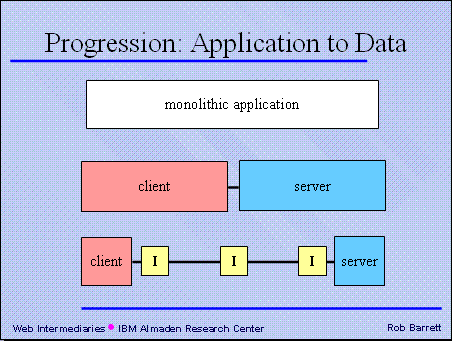
This is from a slide deck that was put together in 1997:
The [I] box stands for 'intermediary'.


See: http://www.almaden.ibm.com/cs/wbi/Publications.html

Intermediary-based programming is still an art. Everyone wants to talk about services... service oriented this, service oriented that... but no one want to talk about "intermediary oriented". I guess it isn't very sexy. I've challenged the SO group to discuss the NFR's of an intermediary; should be interesting. I've also had some interesting discussions on the categories of intermediaries, including stateless, stateful, 'context oriented', header-only processing, payload processing and more.

I have a feeling that a significant focus of 2005 will be on the intermediary programming model. We'll see great discussions on IOD (design) and IOA (architecture) and refactoring portions of fat services into bumps on the network.

Sunday, December 05, 2004

Charcoal Services

If a black boxed service sits in a grey container, what is it?

The Financial CIO

A great quote from a recent Sterling-Hoffman newsletter:

Angel Mehta: Why do you think the climate is so difficult for enterprise software companies, even with the economy having recovered?

Stu Schuster: For as long as I can remember, the process of growing a company has been the Geoffrey Moore, ‘Crossing the Chasm’ approach. When taking technology to market, find the innovators first who buy the technology, and then you go through the early adopters and late adopters, etc. This process, I think, all good high-tech marketers understood.

Throughout my entire career, there were always people who wanted to do something for their organizations that they believed would be a leap forward and would make a name for themselves. Call these the entrepreneurial Chief Information Officer… they were at companies like FedEx or Wal-Mart. They would try to do something with technology that would give the entire company a competitive edge.

After the technology crash, the focus became so oriented around cost-cutting that the entrepreneurial CIO was replaced with a financial CIO. There are so few entrepreneurial CIO’s out there that today everything has to be easy to implement, available by the drink, with very short time to ROI. The innovative buyer, the entrepreneurial CIO has been terminated out of the industry.

Eventually, it’ll cycle again because people will eventually feel that they’ll need a competitive advantage and will look to technology to do that. But today, it’s brutal. It’s amazing how hard it is to find people who are willing to take a chance on a new company or new technology. Fear dominates every IT department. As a result, growing an early stage software company is just harder than ever.

That’s why I place so much more emphasis on the people-side of the equation these days. It doesn’t matter how great the technology is – if the right people aren’t in place, you’ll never convince customers to take a chance.

Thursday, December 02, 2004

The Role of the Application Servers in SOA

I've been using the term "service containers" to refer to the sandbox that services live in. However, in J2EE land, there isn't a 1:1 relationship between the 'software server' and the 'container'. You've got the 'servlet container', 'ejb container', etc. The Application Server is really an all-in-one - super-duper server. It slices, it dices, it does transactions, messages, web pages - you name it - it does it.

App servers can host web services. They can also host platform specific services (RMI, EJB). The services provided can be governed via the container and can leverage additional functionality via components and class libraries (most of the J2EE API's).

Just to restate - build services on top of components that are a combination of classes which sit inside of a governed container while making calls to libraries, some of which are runtime generators, perhaps being fed metadata from model-driven tooling. Agreed?

Ok. Now we need to move into "specialized servers", like identity servers, orchestration servers, etc. Many of these servers were built from the ground up as stand-alone servers, while other implementations were built to sit on top of application servers (e.g., a bpel implementation that runs in JBoss). In the J2EE world, specialized servers are really just new API's governed by the JSR process to encourage yet another container or library to be added to the J2EE server. In some ways, J2EE has become a dumping ground for 'bright ideas'. Hence the movement to 'lightweight containers'.

Now, let's ponder...
Question #1: Would you describe the application server as a "Rapid Service Development" (RSD) environment?

Question #2: To what extent should specialized services reside in generic containers?

Question #3: Should the server be 'pre-glued' together (mandate the download all 55MB of libraries) or should it be more loosely coupled and segmented?

Question #4: What are the necessary cross-cutting concerns that should be considered part of the server or container?

Question #5: What functionality is not a cross-cutting concern, but rather a specialized function?

Question #6: Would you consider the app server to be a "Contract First Container"?

The application server has evolved to meet the needs of the masses. It was designed to be an all-purpose server. Can a developer build SOA based applications in it? Sure. It is more work than it needs to be? Absolutely. And the big question... Do I believe that Rapid Service Development to Contract-First Containers is the way of the future? Yes I do.

Application servers will continue to be used when the architect chooses to use a platform specific component-based development model. Here, the focus is on 'building the application' (hence, "application server") versus building the services.

There are some real challenges that app servers will face in the SOA environment. We can be sure that BEA and IBM will be morphing their offerings to make them more acceptable to the SOA crowd. However, I fear that they will leave all of the garbage behind as well.

It's real simple - if your platform fails the loosely coupled test then so will your business applications that sit on top of them.

Remember: "Rapid Service Development to Contract-First Containers".

Tuesday, November 30, 2004

MS Patterns & Practices are Shallow

The Microsoft Patterns & Practices group released a set of SOA principles. I was eager to see what the brains came up with but found myself beyond disappointed; I found myself actually in awe of their incompetence. Perhaps these are tough words but I'm so extremely disappointed in the group-think that is currently going on in the SOA world that I feel compelled to point it out.

First, the show can be found here:
http://msevents.microsoft.com/cui/WebCastEventDetails.aspx?culture=en-US&EventID=1032262538&CountryCode=US

MS stated four primary tenets to SOA. My first thought was "holy smokes, they got it down to four?!!!" Well, here they are:
1. Boundaries are explicit
2. Services are autonomous
3. Services share schema and contract, not class
4. Service compatibility is based on policy

Boundaries are explicit - yep, hard to argue. But what does this actually say? How about this instead: "All exchanges of data, metadata, logic or other binary asset MUST BE exchanged through a contract. Runtime changes to code dependencies are NOT allowed."

Services are autonomous - Most people know that I firmly believe that "services are not autonomous", they are synergistic. Services work together in a 'service ecosystem'. Services will influence each others metadata. In no way are services autonomous.

Services share schema and contract, not class - I believe the point is that you want to share data using self describing, self validating, extensible schema systems that are ubiquitously deployed. That's cool - use an abstract typing system.

Service compatibility is based on policy - Yes. Agreed.

The patterns group then identified some "anti-patterns" or things not to do:
1. Avoid CRUDy interfaces. Don't use the CRUD pattern.
Guys - this is so wrong I felt sorry for them. After listening to them babble on this for a while all credibility was lost. I think what they meant to say is "Use CRUD, but don't violate the age-old wisdom around fully encapsulating and abstracting the persistence mechanisms. "

The second anti-pattern was avoid "loosely goosey" interfaces. The example they used was something like "runQuery(qry)". This one is tougher. If you really don't know what query combination needs to be run at design time then... you pretty much need something like "runQuery(qry)". This gets into a real interesting space that I wish MS would have talked about. Is it ok to pass XPath statement? Is it ok to pass an XQuery command? What is the right way to solve the runtime predicate problem? Surely the answer isn't "don't solve it". What about the surrogate key problem - where the only primary key is vendor specific key?

The list goes on and on... MS has the brains to do this stuff right. I wish they would ask some of their smart people to help the patterns & practice group get this stuff right.

Tuesday, November 23, 2004

Languages are Less Important

"Languages are Less Important" is one of the simple philosophies in Awesome(tm):

Traditionally, the choice of programming languages in an I.T. department was a near-religous decision. One reason was that the language tended to slither its way from one application to the next. Knowing this, managers would be very careful about allowing a new language into a development shop. In addition, reuse was considered a language specific mining activity (no one tried to pull Java code out of one application and put it in a Perl application). On top of this was the obvious fact that all of the enterprise API's were language specific, including J2EE and .Net.

Enterprises that implement Contract First Design and believe that Platforms are Contract Driven are much less dependent on specific languages or language specific libraries. Now, with this said - languages are still important for some real good reasons including: Developers skilled in one language shouldn't have to learn a new language for every different service they run into. Most I.T. shops already have large investments in platform specific code bases that they will want to leverage.

Although languages are less important in a service oriented world, they are still important. As services become more popular it will be common to find languages which are more friendly towards service development. This may be based on their ability to work with the Web Service standards, to expose themselves as a service or to invoke a service.


Well, it seems as though Peter Yared understood this some time back. Unlike the scores of startups that re-create the same damn product using all the same damn technologies... ActiveGrid made a hard left turn. The company appears to have come to the obvious realizations that no one else seems to have the guts to admit:
1. J2EE is a bloated set of deprecated patches.
2. Static Java objects and dynamic XML collide
3. Contract first programming make "languages less important"
4. If you're in an SO world, you might as well pick an SO friendly language
5. J2EE was designed to scale across a VM that sits on a multi-CPU box
6. Oh, Sun owns Java and J2EE, and what do you know... they sell multi-CPU boxes
7. Rip & replace Intel/AMD/Linux boxes are fast, cheap and reliable
8. LAMP is here to stay.
9. The growth rate of transactions inside an enterprise is significant.
10. The last-gen computing method will hit an 'economic breaking point'.

ActiveGrid is a "market starter"; the door has just been opened to commoditize the OS, the language and the vm while kicking big boxes in the groin and enabling service developers to be more productive while offering a lower cost of computing. Interesting? Uh, yes.

Friday, November 19, 2004

"Design by Contract" or "Contract First"?

I'm trying to clean up some terminology that I've been using in the Awesome(tm) method. The latest is the term "design by contract(tm)". This is a term that Bertrand Meyer coined (and trademarked). He used it in the context of object oriented programming where the focus was on "pre- and post-conditions and class invariants".

Don Box, Christian Weyer and others have favored the term "contract first" to describe a similar concept more suitable to web services. Here the focus has been on giving a service the ability to advertise:
- Type definitions
- Message definitions
- Operations (inbound and outbound)
- Message Exchange Patterns (e.g., request/response)
- Interfaces (groups of operations)
- Bindings

However, it is apparent that the contract goes beyond the basic wsdl stuff. It must also include:
- Pre-conditions / post-condition assertions
- Non-functional policies (security, reliability, transactional integrity)
- Hosted service level agreements (availability, latency)
- Synchronicity capabilities (asynch, synch or bi-synch)

Eventually the contracts will include stuff like:
- Semantic ontology (or other semantic broker)
- Costing /recharge functions
- Estimates to run service (think big-O)
- Preferred translator service (don't understand SOAP 1.5, but do understand SOAP 1.3)
- Code mobility agreements
- Service-to-service automated recompilation agreements (HotSpot for SO)
- Service dependencies (other services and resources)
(many of these will show up as standardized interfaces implemented by a service container)

I guess what I'm saying is that "design by contract" doesn't mean the same thing that we are talking about in the service oriented world. Hence, "Contract First" it is!


-----
Here's one to ponder... what pieces of the contract should be in a document format (like WSDL) versus in an interface format (like ws-mex). Or should they be in both? Why doesn't WSDL have a WSDL interface: getOperations()?? Is the ws-mex, getMetadata() the right way to go? Or should you look at it as an enterprise vocabulary problem? "GET" + "OPERATION" (think ws-transfer). Or is it a semantic ontology problem where you have "GET" and a pre-condition stating you can only get things that 'are a kind of' "METADATA"... Well, doesn't really matter - looks like we will have every combination possible. :-)